The Ultimate Guide to Foods That Help Kids Focus & Concentrate
Science-backed nutrition strategies for every age — without the overwhelm
The Real Reason Your Kid “Can’t Pay Attention” (It’s Not What You Think)
If you’re searching for foods to help kids focus, you’re probably dealing with a very real 7am problem — and the answer is closer than you think.
Before you spiral into guilt or google “ADHD symptoms” for the third time this week — pause.
Because here’s what the research actually shows: a significant portion of focus and attention problems in children are directly linked to what they ate (or didn’t eat) that day.
Not a character flaw. Not a parenting failure. Breakfast.
This guide breaks down exactly which nutrients build concentration from the inside out, which foods deliver them in ways kids will actually eat, and how to make it all work on a Tuesday morning when you have 11 minutes before the bus arrives.
No perfection required. Just progress.
Table of Contents
💬 Expert Perspective
“A nutritious and balanced diet can help children focus, behave better, and get along with others. The brain needs nutrients for brain function — especially iron, omega-3 fatty acids, protein, and a host of other nutrients. From complex carbs to healthy fats, a nutritious diet is like washing the brain in the nutrients it needs to function optimally.”
— Jill Castle, MS, RDN — Pediatric Dietitian, Former Clinical Nutritionist at Boston Children’s Hospital, Author & TEDx Speaker. Founder of The Nourished Child® 📖 Source: The Best Diet for Kids with ADHD to Eat — The Nourished Child®
“Not only do nutritious meals offer a variety of important nutrients for the brain, such as iron, zinc, vitamin B12, choline, and omega-3 DHA, they also support energy levels and executive function, including focus and impulse control.”
— Jill Castle, MS, RDN — on brain nutrients and daily cognitive performance 📖 Source: How to Help the Child with ADHD Who Needs to Gain Weight — The Nourished Child®
🧠 Why Science Prefers Foods to Help Kids Focus ?
Your child’s brain is, quite literally, under construction. From toddlerhood through adolescence, the prefrontal cortex — the region responsible for attention, impulse control, and decision-making — is the last part of the brain to mature. It won’t be fully developed until their mid-20s.
That means it’s also the most nutritionally sensitive region during childhood.
Three biological mechanisms drive your child’s ability to focus:
1. Stable blood glucose — The brain runs on glucose. Spikes and crashes (hello, sugary cereal) create the neurological equivalent of a power outage mid-sentence. Complex carbohydrates from whole grains release glucose slowly, keeping the mental lights on.
2. Neurotransmitter production — Dopamine and norepinephrine are the brain’s “attention chemicals.” They’re synthesized directly from dietary amino acids (protein) and regulated by micronutrients like iron, zinc, and B vitamins. No nutrients = no raw materials = no focus.
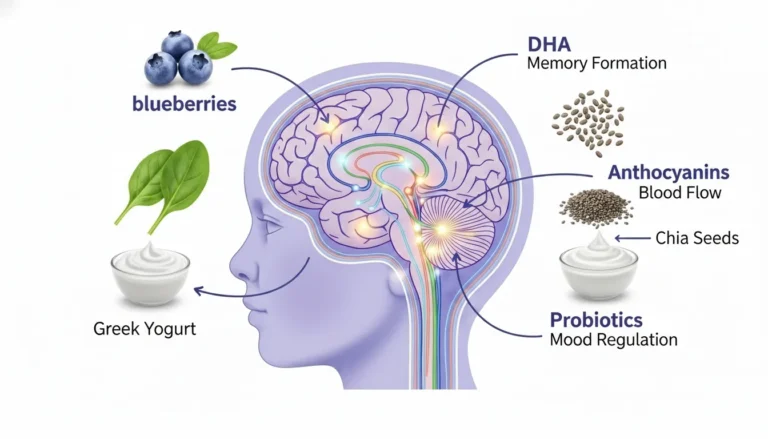
3. Myelin integrity — Myelin is the fatty sheath that insulates neural pathways, making signals travel faster and more accurately. Omega-3 fatty acids (specifically DHA) are its primary building block. A brain low in DHA is literally slower to process information.
The bottom line : Focus isn’t just willpower. It’s biochemistry. And biochemistry responds to food. Choosing the right foods to help kids focus is one of the most direct levers parents have.
🔬 The Focus Nutrients: Your VIP List
| Nutrient | Brain Role for Focus | Best Food Sources |
|---|---|---|
| DHA (Omega-3) | Builds myelin, speeds neural signals, reduces brain inflammation | Salmon, sardines, chia seeds, walnuts |
| Iron | Transports oxygen to the brain; iron deficiency = #1 nutritional cause of attention problems | Lentils, lean beef, spinach + Vitamin C |
| Zinc | Regulates dopamine signaling in the prefrontal cortex | Pumpkin seeds, chickpeas, cashews |
| Choline | Produces acetylcholine — the neurotransmitter of sustained attention | Eggs (yolk!), edamame, chicken |
| Magnesium | Calms neural hyperactivity; low levels linked to restlessness | Dark chocolate (70%+), avocado, black beans |
| B Vitamins (B6, B12, Folate) | Energy metabolism in brain cells; neurotransmitter synthesis | Eggs, leafy greens, oats, dairy |
| Vitamin D | Modulates serotonin and dopamine production | Fatty fish, fortified milk, eggs |
| Complex Carbs | Steady glucose supply = sustained mental energy | Oats, brown rice, sweet potato, whole wheat |
🍽️ The Brain-Boost Food Chart: Focus Edition
| Food | Sustained Energy | Dopamine Support | Neural Speed | Calming Effect |
|---|---|---|---|---|
| 🐟 Salmon | ★★★ | ★★★ | ★★★★★ | ★★★ |
| 🥚 Eggs | ★★★★ | ★★★★ | ★★★ | ★★ |
| 🫐 Blueberries | ★★ | ★★★ | ★★★ | ★★★★ |
| 🥣 Oats | ★★★★★ | ★★ | ★★ | ★★★ |
| 🥑 Avocado | ★★★★ | ★★ | ★★★ | ★★★★★ |
| 🎃 Pumpkin Seeds | ★★★ | ★★★★★ | ★★★ | ★★★★ |
| 🍫 Dark Chocolate | ★★ | ★★★★ | ★★ | ★★★★★ |
| 🥬 Spinach | ★★★ | ★★★ | ★★★★ | ★★★ |
👶🧒🧑 How to Serve by Age ?
🍼 6–18 Months
- Salmon: puréed or soft-flaked, mixed with sweet potato
- Eggs: scrambled very soft, or yolk stirred into veggie purée
- Lentils: puréed into soups with a squeeze of orange (Vitamin C boosts iron absorption by up to 67%)
- Avocado: mashed, as-is — nature’s perfect baby food
- ⚠️ Avoid honey, whole nuts, and added salt at this stage
🧒 18 Months – 3 Years
- Eggs any style — this age group typically accepts eggs in more forms than any other food
- Oat-based breakfasts with hidden chia seeds (they dissolve completely, tasteless)
- Salmon fishcakes shaped into animals or stars
- Smoothies with spinach + frozen mango — the color goes green-ish but tastes like mango
- 🎯 Goal: aim for 2–3 focus nutrients per day, not all of them
🏫 4–8 Years (School Age — Critical Window)
- The non-negotiable: a protein + complex carb breakfast before school
- Lunchbox strategy: include one omega-3 source 3–4x per week
- After-school snack: avocado toast or apple + almond butter over crackers + juice
- 🎯 Goal: stabilize blood sugar through the school day
🎒 9–12 Years (Pre-Adolescence)
- Iron needs increase, especially for girls approaching puberty
- Magnesium becomes increasingly important for stress regulation
- They can now understand why — explaining “this helps your brain stay sharp during tests” actually works
- Involve them in Sunday prep
- 🎯 Goal: shift from parent-controlled to child-involved eating
🥗 Dietary Adaptations
| Diet | Key Challenge | Solutions | Star Ingredient |
|---|---|---|---|
| 🌱 Vegan / Plant-Based | DHA + B12 scarce in plant foods | Algae-based DHA supplement; fortified plant milks; lentils + citrus at every iron-rich meal | Hemp seeds — complete protein + omega-3 + zinc in one ingredient |
| 🚫 Dairy-Free | Calcium + B12 + probiotic sources | Fortified oat or almond milk; coconut yogurt with chia | Avocado — replaces dairy fat in most recipes without altering flavour |
| 🥜 Nut-Free | Zinc + healthy fat sources for school lunchboxes | Pumpkin seeds + sunflower seeds; sunflower seed butter replaces peanut butter | Hemp hearts — sprinkle on anything, tasteless, zinc + omega-3 |
| 🌾 Gluten-Free | Replacing whole grain complexity | Certified GF oats; brown rice + legume combinations | Quinoa — complete protein + iron + magnesium, superior to most grains |
😤 Picky Eater Strategy: The Real Playbook
The pressure to get kids to eat “brain foods” often backfires spectacularly. Anxiety at the table triggers cortisol, which suppresses appetite. So the first strategy is: take the urgency out of individual meals.
The Exposure Game (No Pressure Edition)
It takes 10 to 15 neutral exposures before many children will try a new food. Serve the new food alongside 2–3 accepted foods. Never comment if they don’t eat it. Just keep it appearing.
The Sneak-It vs. Show-It Strategy
| Approach | Best For | Examples |
|---|---|---|
| Sneak-It | Nutrients in foods they already love | Chia in yogurt, spinach in smoothies, lentils blended in tomato sauce |
| Show-It | Building long-term food literacy | “These seeds make your brain fast” + let them sprinkle pumpkin seeds themselves |
| Combo | 4+ year olds | Sneak the nutrition, show the ingredient separately as a “helper food” |

💡 Noah’s Pro Tip: The MiniChef Signature Move
” Want to know the secret to getting kids to actually eat what their brain needs? Let them build it! Whether it’s assembling their own oat bowls, taco-style salmon wraps, or pressing the blender button for a smoothie, participation is the ultimate ‘brain fuel.’ When they build it, they eat it! 🖐️ “
⏱️ The Sunday Prep: 30 Minutes, 5 Focus-Boosting Components
The simplest way to serve foods to help kids focus consistently is to prepare them in advance. Complexity kills execution — so here’s the MiniChef 30-minute Sunday system:
- Hard-boil 8 eggs (10 min, passive)
- Cook a pot of oats (store in fridge, reheat in 90 seconds)
- Portion pumpkin seeds + chia into small jars
- Wash and spin berries
- Open and flake 2 tins of salmon
Total active time: ~25 minutes. Every focus nutrient on the VIP list deployed all week.
🍳 Recipes: The Focus Kitchen
Recipe 1 — The Focus Bowl (Breakfast)
The signature MiniChef recipe — all 6 focus nutrients in one bowl.
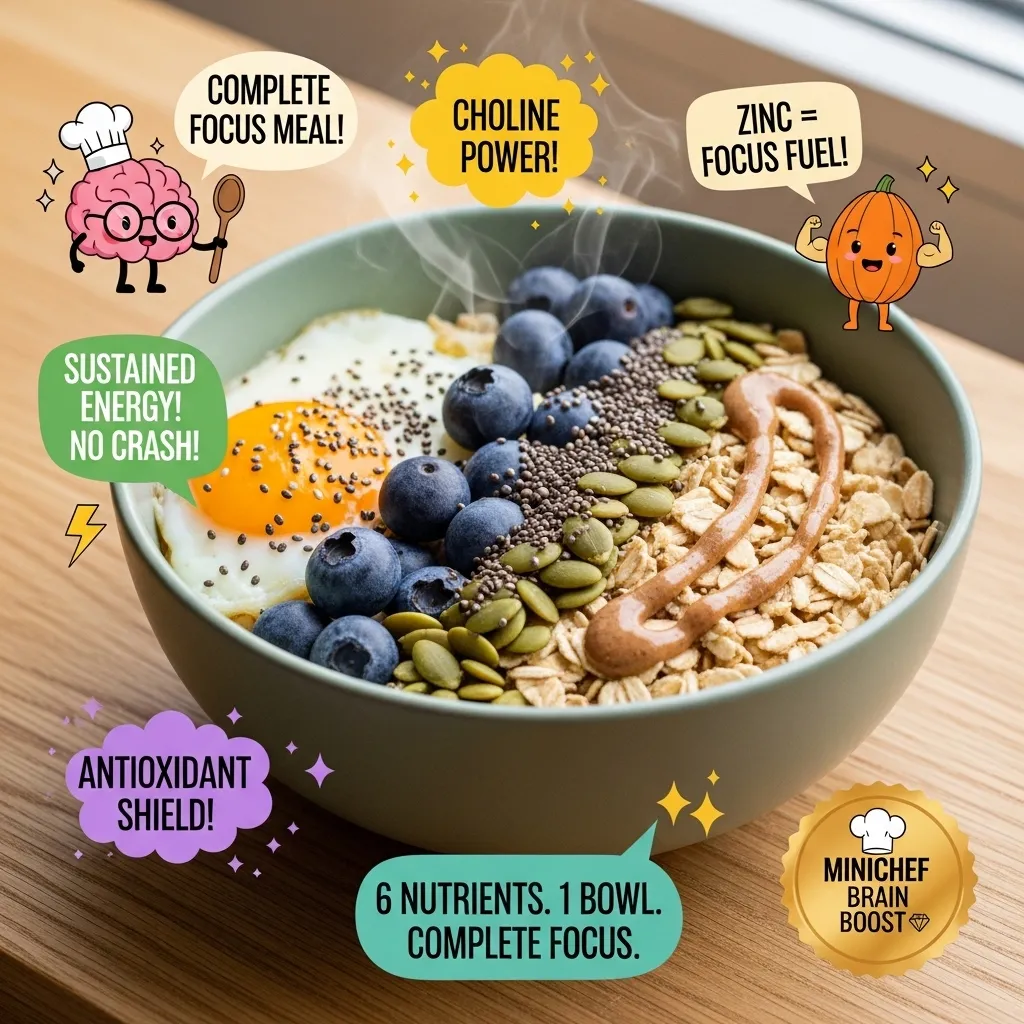
Serves: 1 child | Prep: 5 min | Cook: 5 min
| Ingredient | Quantity | Notes |
|---|---|---|
| Rolled oats | ½ cup | — |
| Egg | 1 | Soft-scrambled |
| Blueberries | ¼ cup | Fresh or frozen, thawed |
| Chia seeds | 1 tsp | — |
| Pumpkin seeds | 1 tsp | — |
| Almond butter | 1 tsp | Or sunflower seed butter (nut-free) |
| Milk of choice | Splash | Any variety |
Method :
- Cook oats with milk to your child’s preferred consistency.
- Soft-scramble the egg separately — keep it creamy.
- Layer oats in bowl, place egg alongside or on top.
- Add blueberries, then scatter chia and pumpkin seeds.
- Finish with a small swirl of nut/seed butter.
Why it builds brains ?
Oats = sustained glucose. Egg = choline + protein. Blueberries = antioxidants. Seeds = zinc + DHA. Nut butter = magnesium + healthy fats. Every focus nutrient, one bowl, 10 minutes.
Age adaptation:
under 18 months — omit seeds, mash blueberries, serve egg and oats combined.
Recipe 2 — Berry Blast Focus Smoothie (Breakfast / Snack)
The ultimate sneak-it weapon — spinach completely hidden, brain nutrients front and center.
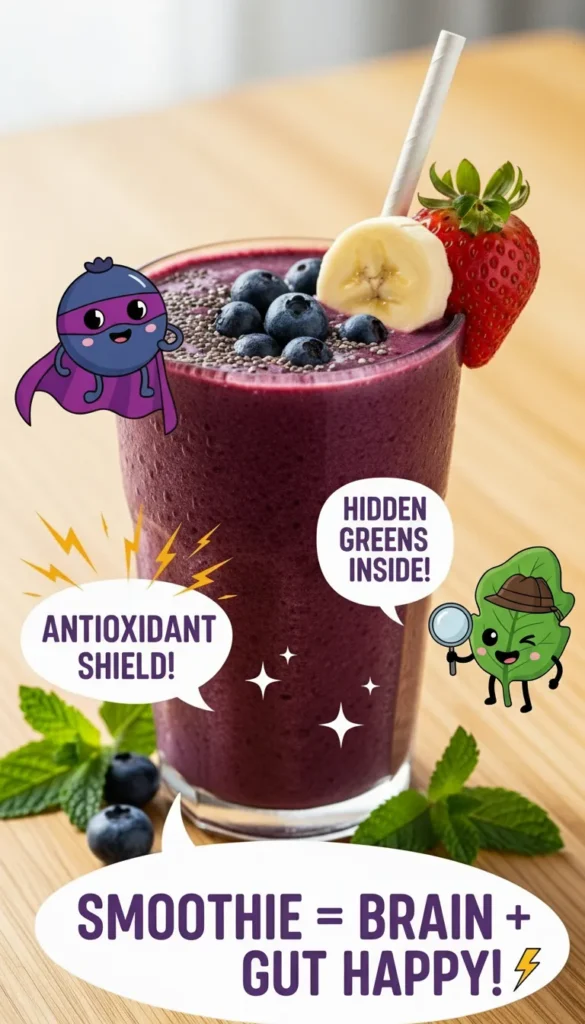
Serves: 1–2 children | Prep: 5 min | Cook: 0 min
| Ingredient | Quantity | Notes |
|---|---|---|
| Greek yogurt | ½ cup | Or coconut yogurt (dairy-free) |
| Frozen mixed berries | ½ cup | Blueberries, strawberries |
| Fresh spinach | 1 handful | They won’t taste it, promise |
| Banana | ½ | Frozen |
| Chia seeds | 1 tsp | — |
| Flaxseeds | 1 tsp | Ground |
| Milk of choice | ½ cup | Any variety |
| Honey | 1 tsp | Optional — kids over 12 months only |
Method :
- Add yogurt and milk to blender first — this prevents the spinach from sticking.
- Add frozen berries, banana, spinach, chia and flaxseeds.
- Blend on high for 45 seconds until completely smooth.
- Pour into a fun cup with a straw — presentation matters at this age.
- Serve immediately or store in fridge up to 4 hours.
Why it builds brains ?
Berries = anthocyanins for brain cell protection. Spinach = folate + iron for oxygen flow. Yogurt = probiotics for the gut-brain axis. Chia + flax = plant-based omega-3. This smoothie covers antioxidants, iron, B vitamins, and DHA in one cup.
Picky eater tip
start with more banana and fewer berries, gradually shift the ratio over 2–3 weeks. The spinach is truly undetectable behind frozen berries.
Age adaptation
6–12 months — skip honey, thin with extra milk, serve as a spoonable purée.
Recipe 3 — Salmon Fishcakes (Lunch / Dinner)
These patties are among the best foods to help kids focus because of their high DHA content.
The #1 way to get omega-3 into kids who “don’t like fish” — crispy outside, soft inside, zero fishy taste.
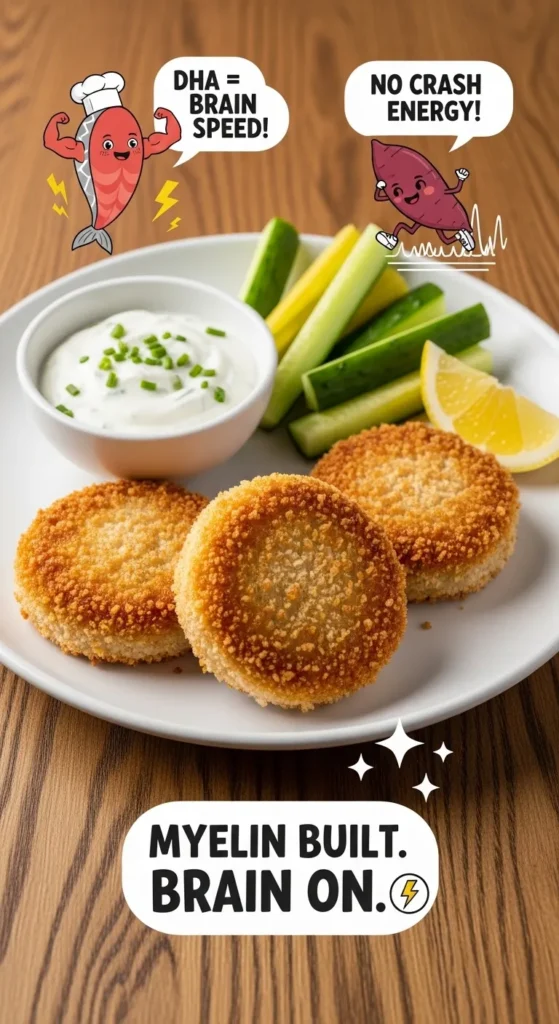
Serves: 2 children (6 small fishcakes) | Prep: 15 min | Cook: 10 min
| Ingredient | Quantity | Notes |
|---|---|---|
| Tinned salmon | 120g (1 tin) | Drained and flaked |
| Sweet potato | 1 medium (~¾ cup) | Cooked and mashed |
| Egg yolk | 1 | — |
| Breadcrumbs | 2 tbsp | GF breadcrumbs work perfectly |
| Fresh chives or parsley | 1 tbsp | Finely chopped |
| Garlic powder | ¼ tsp | — |
| Salt | Pinch | For children over 12 months only |
| Olive oil | 1 tbsp | For pan-frying |
Method :
- Mix salmon, mashed sweet potato, egg yolk, chives, and garlic powder in a bowl until combined.
- Shape into 6 small patties — roughly the size of a child’s palm.
- Roll each patty lightly in breadcrumbs for a crispy coating.
- Heat olive oil in a non-stick pan over medium heat.
- Cook fishcakes 3–4 minutes per side until golden and heated through.
- Serve with cucumber sticks and a yogurt-based dip.
Why it builds brains ?
Salmon = DHA + EPA for myelin building and neural speed. Sweet potato = complex carbs + beta-carotene for sustained energy. Egg yolk = choline for memory. Olive oil = healthy monounsaturated fats for brain cell integrity. This single recipe covers 4 of the 8 VIP focus nutrients.
Picky eater tip
the sweet potato completely masks any fish flavour — the texture is closer to a potato cake than a fishcake. Shape them into stars or dinosaurs with a cookie cutter for the 18 months–4 year age group.
Age adaptation
6–12 months — skip salt and breadcrumbs, mash the patty flat and serve as finger food strips.
Recipe 4 — Zinc Power Snack Board (After-School Snack)
The 5-minute snack that beats every processed option — and covers the post-school glucose crash exactly when it hits hardest.
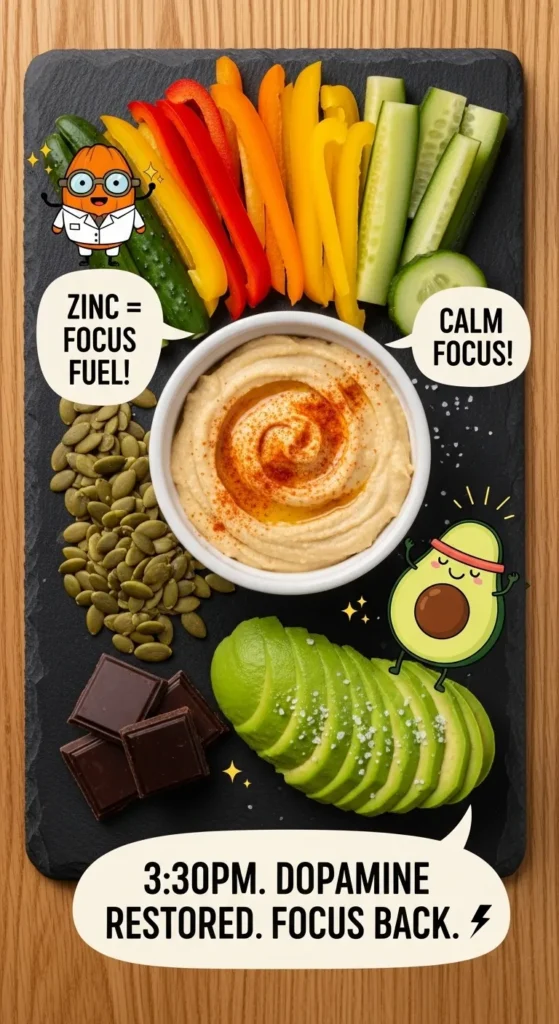
Serves: 1–2 children | Prep: 5 min | Cook: 0 min
| Ingredient | Quantity | Notes |
|---|---|---|
| Pumpkin seeds | 2 tbsp | — |
| Cashews | 1 tbsp | Or sunflower seeds (nut-free) |
| Dark chocolate (70%+) | 2 squares | Broken into pieces |
| Avocado | ¼ | Sliced |
| Sea salt | Small pinch | On avocado |
| Hummus | 4 tbsp | — |
| Rainbow bell pepper strips | Handful | Red, yellow, orange |
| Cucumber | 3–4 rounds | — |
Method :
- Place hummus in a small bowl in the center of a plate or small board.
- Arrange pepper strips and cucumber rounds around the hummus.
- Place pumpkin seeds and cashews in a small cluster.
- Add dark chocolate pieces and avocado slices.
- Serve immediately — the whole thing takes under 5 minutes.
Why it builds brains ?
Pumpkin seeds = zinc to regulate dopamine in the prefrontal cortex (your child’s attention center). Dark chocolate = magnesium + flavonoids for calm focus without a sugar rush. Avocado = magnesium + healthy fats for myelin. Hummus = iron + protein + zinc. Bell peppers = Vitamin C which boosts iron absorption by up to 67%. This snack board is specifically engineered for the 3:30pm–5pm window when blood glucose crashes hardest after school.
Picky eater tip
serve on a small wooden board instead of a plate — the “snack board” presentation makes it feel special and different from a regular snack. Kids are significantly more likely to try new foods in a grazing format than when served on a plate.
Age adaptation
12–18 months — skip whole cashews (choking hazard), finely chop pumpkin seeds, serve avocado mashed, omit dark chocolate until 2 years.
🧾 Keep Exploring: More Foods to Help Kids Focus
Want to keep building your child’s focus toolkit ?
These three recipes were chosen because each one targets a specific cognitive gap — the morning energy dip, the omega-3 deficit, and the after-school crash. Together, they complete what this guide started.
🥚 Golden Scrambled Eggs with Grass-fed Butter: The Brain Fog Eraser Your Kids Actually Want to Eat
Eggs are one of the most reliable foods to help kids focus before school — and this recipe makes them irresistible. Rich in choline, the neurotransmitter precursor that powers memory and sustained attention, this 5-minute breakfast does more cognitive work than most parents realise.
👉 Perfect for: applying the Choline strategy from our VIP Nutrients section.
🥣 Omega-3 Smoothie Bowl for Focus: Flaxseed, Chia & Walnut Brain-Building Breakfast Kids Actually Eat
When salmon isn’t on the morning menu, this bowl quietly delivers the plant-based omega-3s that build myelin and sharpen neural speed. One of the most practical foods to help kids focus for families following a plant-based or nut-inclusive diet.
👉 Perfect for: the Vegan & Dairy-Free adaptations covered in our Dietary section.
🥤 The After-School Brain Recharge Smoothie: How One 5-Minute Drink Transforms Homework Meltdowns
❓ FAQs
These are the questions parents ask most often about nutrition and children’s concentration :
How quickly will I see a difference in my child’s focus after changing their diet?
Blood glucose stabilization happens within days — you may notice fewer afternoon crashes almost immediately. Structural brain changes from omega-3s take 8–12 weeks of consistent intake.
Is breakfast really that important for school focus, or is it overhyped?
The research is genuinely strong here. Children who eat a protein + complex carb breakfast perform measurably better on attention tasks in the late morning compared to those who skip or eat high-sugar breakfasts.
My child only eats about 5 foods. Where do I even start?
Start with the Sunday prep list and focus only on adding one thing per week, not removing anything. Even one improvement (chia seeds in their yogurt, pumpkin seeds as a snack) delivers real cognitive benefit.
Are focus supplements worth it for kids?
For most children eating a varied diet, no. The one exception supported by strong evidence is algae-based DHA for children who don’t eat fish. Always discuss with your paediatrician.
What foods should I actively reduce for better focus?
Added sugars (especially in drinks), artificial food colourings, and ultra-processed snacks with refined carbs. You don’t need to eliminate — just reduce frequency and replace with the snack ideas above.
💡 Noah says:
“You don’t need to do all of this at once. Pick one recipe. Try it this week. That’s already a win for your child’s brain — and honestly, for you too. Small steps, real results. That’s the MiniChef way.”
The Bottom Line
Feeding a sharp, attentive child doesn’t require a nutrition degree or a spotless meal plan. It requires consistency over perfection—and that is 100% achievable when you prioritize the right foods to help kids focus.
Start with the Sunday prep. Add one seed to one meal. Swap one sugary snack for a “Zinc Power Board”—an easy way to serve varied foods to help kids focus, like pumpkin seeds and cashews. The brain is remarkably responsive to good nutrition. And so are kids, when we stop making mealtimes a battle and start making them a collaboration.
📚 Scientific References
The nutritional claims in this article are grounded in peer-reviewed research. Key sources below:
Omega-3 / DHA & Focus
- Derbyshire, E. (2018). Brain Health across the Lifespan: A Systematic Review on the Role of Omega-3 Fatty Acid Supplements. Nutrients. PMC — Read study
- Wongsurawat, T. et al. (2022). Fish Oil-DHA Supplementation for Cognitive Function in Thai Children: A Randomized, Double-Blind, Placebo-Controlled Clinical Trial. PMC. — Read study
- Hadley, K.B. et al. (2016). The Relationship of DHA with Learning and Behavior in Healthy Children: A Review. PMC. — Read study
- Cooper, R.E. et al. (2015). Omega-3 Polyunsaturated Fatty Acids in Youths with ADHD: a Systematic Review and Meta-Analysis. Neuropsychopharmacology, Nature. — Read study
Iron & Cognitive Development 5. Falkingham, M. et al. (2023). Effects of Iron Supplementation on Cognitive Development in School-Age Children: Systematic Review and Meta-Analysis. PLOS One. — Read study 6. Lozoff, B. et al. (2006). Iron Deficiency in Infancy and Neurocognitive and Educational Outcomes in Young Adulthood. PMC. — Read study 7. Jáuregui-Lobera, I. (2014). Iron Deficiency, Cognitive Functions, and Neurobehavioral Disorders in Children. PubMed. — Read study
Choline & Memory / Attention 8. Schwarzenberg, S.J. et al. (2022). Association between Maternal Choline, Fetal Brain Development, and Child Neurocognition: Systematic Review and Meta-Analysis. PMC. — Read study 9. Caudill, M.A. et al. (2019). Choline, Neurological Development and Brain Function: A Systematic Review Focusing on the First 1000 Days. MDPI Nutrients. — Read study 10. Boeke, C.E. et al. (2013). Choline Intake During Pregnancy and Child Cognition at Age 7 Years. PMC. — Read study 11. Bahnfleth, C.L. et al. (2022). Prenatal Choline Supplementation Improves Child Sustained Attention: A 7-Year Follow-Up of a Randomized Controlled Feeding Trial. PMC. — Read study
This article was last reviewed March 2026. MiniChef Recipes does not provide medical advice. Always consult your paediatrician for personalised nutritional guidance.