
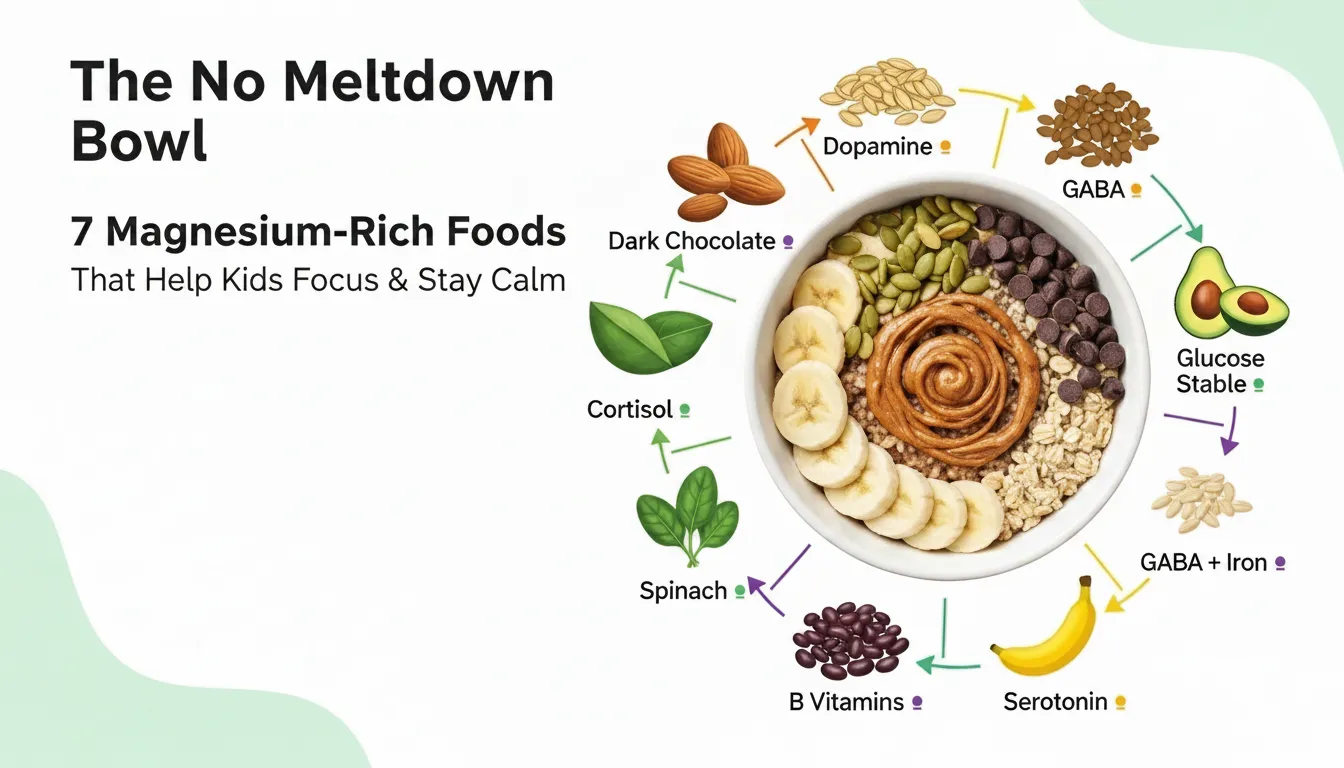
Magnesium Rich Foods for Kids: 7 Brain-Calming Foods and Easy Meals That Help Kids Focus
Magnesium rich foods for kids include pumpkin seeds, dark chocolate, avocado, oats, spinach, black beans, and bananas. Magnesium regulates GABA — the brain’s natural “calm” neurotransmitter — reducing anxiety, hyperactivity, and focus problems in children.
If you are looking for easy, kid-friendly magnesium rich recipes, look no further. From our signature “Hulk” Green Smoothie to nutrient-dense snacks, these 7 brain-boosting meals are designed to help kids focus, sleep better, and improve emotional regulation.
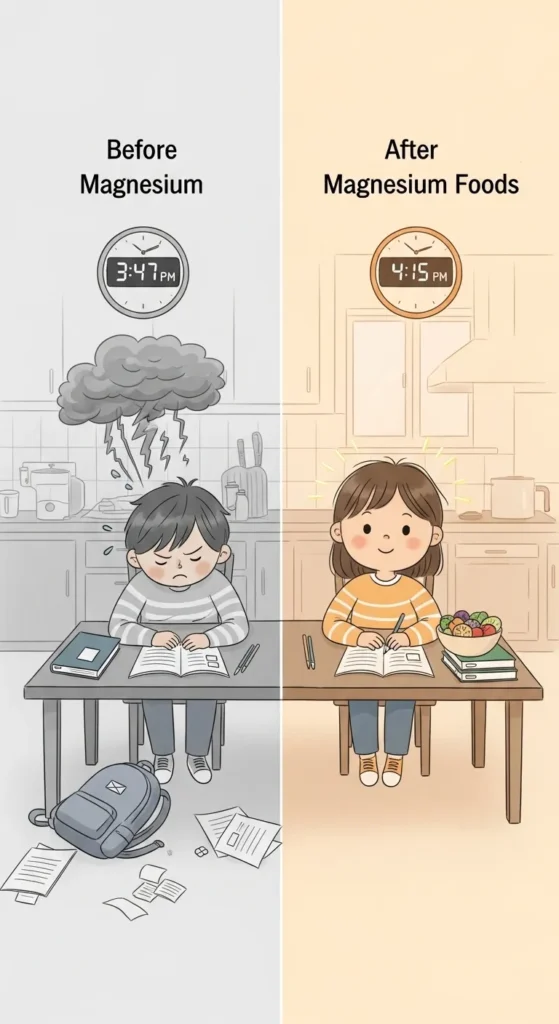
It’s 4:15 PM. Your kid just walked in from school. Backpack hits the floor. The meltdown starts before you’ve even said hello. You’ve tried the snacks, the screen limits, the deep breaths. You’re doing everything right — and it’s still not working.
Here’s something nobody talks about: one mineral deficiency can make even the most patient child act like they’ve skipped a nap and had three sodas. That mineral is magnesium — and most kids aren’t getting enough of it.
The good news? You don’t need a supplement prescription or a complicated meal plan. You need seven magnesium rich foods, most of which your kids already kind of like. Let’s break it down.
Table of Contents
🧠Why This Builds Brains ? The Science (Simplified)
A March 2026 review newly reported by ScienceDaily — based on research led by Swansea University and published in the peer-reviewed journal Nutrients — analyzed 19 studies on adolescent diet and mental health. The core finding: healthier overall dietary patterns are consistently linked to fewer symptoms of depression and psychological distress. Whole-diet approaches outperform isolated supplements every time.
Magnesium sits at the center of this picture. Here’s why it matters for your child’s brain specifically:
Magnesium activates GABA receptors — the brain’s natural “off switch” for hyperactive neurons. Low magnesium = less GABA = more noise in the system.
Magnesium helps regulate cortisol, the stress hormone. When cortisol spikes, focus disappears. Magnesium keeps that spike in check.
Better sleep → better focus the next day. Magnesium supports melatonin synthesis, which is why magnesium-deficient kids often sleep poorly.
📈 Recommended Daily Magnesium Intake for Children (RDA)
| Age Group | Daily Recommended Magnesium (mg) | MiniChef Equivalent |
| 1–3 Years | 80 mg / day | ½ banana + 1 tbsp pumpkin seeds |
| 4–8 Years | 130 mg / day | 1 serving of No Meltdown Bowl |
| 9–13 Years | 240 mg / day | 1 No Meltdown Bowl + 2 squares dark chocolate |
🥗Dietary Adaptations
| Diet Type | Modification | Key Neuro Benefit |
|---|---|---|
| Nut-Free 🌻 | Recipe is naturally nut-free as written. Pumpkin seeds are seeds, not nuts — safe for most nut-free diets. Confirm with your child’s school policy. | Pumpkin seeds deliver zinc alongside magnesium, supporting steady dopamine regulation without any nut allergen risk. |
| Dairy-Free 🥥 | Replace Greek yogurt with unsweetened coconut yogurt or oat-based plain yogurt. For the liquid, use unsweetened almond milk or coconut milk — both are the preferred choice here anyway. | Removes casein, which can trigger low-grade gut inflammation in sensitive kids, ensuring maximum magnesium absorption through a calmer digestive tract. |
| Gluten-Free 🌿 | Use certified gluten-free oats (standard oats are often cross-contaminated). The rest of the recipe is naturally gluten-free. | Certified GF oats deliver the same steady glucose and magnesium load without triggering gut inflammation that would compete with mineral absorption. |
| Vegetarian 🫘 | Recipe is already 100% vegetarian as written. For extra plant-based protein, stir in 1 tbsp of hemp seeds — they add 3g protein and a bonus 27mg of magnesium per tablespoon. | Hemp seeds provide all 9 essential amino acids, including tryptophan — the direct precursor to serotonin — amplifying the calming effect of the bowl. |
| Low-Carb 🥒 | Replace oats with 3 tbsp of chia seeds soaked for 15 minutes. Top with avocado slices instead of banana. | Chia seeds deliver 95mg of magnesium per 30g — comparable to oats — while keeping net carbs minimal and adding omega-3 ALA for additional anti-inflammatory brain support. |
🔬 The Magnesium-ADHD Connection: The Numbers
Magnesium is one of the body’s most powerful natural calmers. It regulates calcium inside brain cells, prevents overstimulation, and helps balance stress hormones like cortisol. When kids don’t have enough magnesium, they’re more likely to experience irritability, anxiety, poor sleep, and difficulty concentrating.
Source: Dr. Roseann’s Podcast: 10 Ways Magnesium Helps the Brain
Dr. Roseann Capanna-Hodge, LPC, BCN Board Certified Neurofeedback Provider · Integrative Children’s Mental Health Expert Founder, Global Institute of Children’s Mental Health · Author, It’s Gonna Be OK!
Studies published on PubMed consistently show that 65–95% of children with focus and attention challenges have measurably lower serum magnesium levels compared to neurotypical peers. A randomized clinical trial confirmed that magnesium combined with Vitamin D caused significant improvements in conduct problems, anxiety scores, and social functioning in children with ADHD after just 8 weeks of intervention. 📖 Source: PMC7011463
Even for children without a clinical diagnosis, chronic low magnesium creates a functional attention deficit — one that looks like ADHD, gets treated like ADHD, but responds dramatically to dietary change.
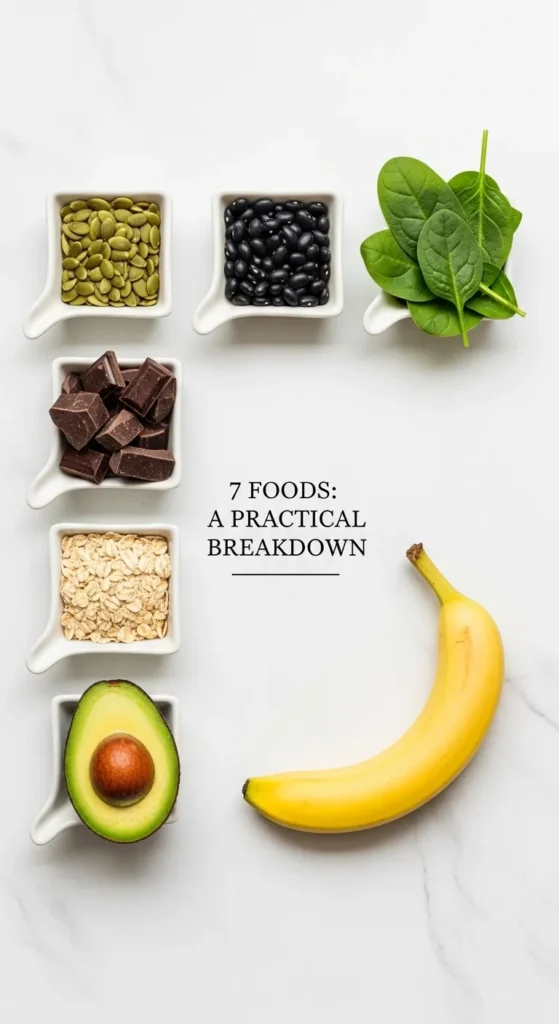
The 7 Magnesium Rich Foods: A Practical Breakdown
We ranked each food on picky-eater friendliness (from 1–5) because knowing something is healthy means nothing if it ends up in the trash.
| Food | Magnesium | Brain Benefit | Picky Eater Score |
|---|---|---|---|
| 🎃 Pumpkin Seeds | 156mg / 30g | Dopamine regulation + zinc | ★★★☆☆ |
| 🍫 Dark Chocolate (70%+) | 64mg / 30g | GABA activation + mood | ★★★★★ |
| 🥑 Avocado | 58mg / ½ fruit | Cortisol reduction + healthy fats | ★★★★☆ |
| 🥣 Oats | 57mg / cup | Steady glucose + calm energy | ★★★★★ |
| 🥬 Spinach (hidden) | 78mg / cup | GABA + iron for oxygen transport | ★★☆☆☆ (hideable ✓) |
| 🫘 Black Beans | 60mg / ½ cup | B vitamins + steady energy | ★★★☆☆ |
| 🍌 Banana | 32mg / medium | Serotonin precursor + potassium | ★★★★★ |
🎃 Pumpkin Seeds — The Overlooked Powerhouse
At 156mg per 30g serving, pumpkin seeds are the most concentrated magnesium rich food on this entire list — delivering more magnesium per ounce than almost any other whole food. They also contain zinc — the same dopamine-regulating mineral featured in our steak nuggets article — creating a powerful cognitive synergy.
Picky eater strategy: Roast with a light coating of olive oil and a pinch of cinnamon. The sweet-savory combination converts even resistant eaters. Sprinkle over oatmeal or yogurt to make them invisible.
🍫 Dark Chocolate (70%+) — The Brain Food They’ll Actually Ask For
Dark chocolate activates GABA receptors, increases cerebral blood flow, and delivers flavonoids that protect neurons from oxidative stress. The 70%+ threshold matters: below that, sugar content undermines the neurological benefits.
Picky eater strategy: 2 squares after school as a deliberate “brain snack.” Framing matters — “this helps your brain work better” lands differently than “eat your dark chocolate.” Kids internalize the narrative.
🥑 Avocado — The Cortisol Killer
Avocado combines magnesium with monounsaturated fats that support myelin production — the insulation around neural pathways that makes thinking faster. Its cortisol-suppressing effect makes it particularly powerful served at after-school snack time, precisely when cortisol peaks after a stressful day.
Picky eater strategy: “Green butter” on toast. Mash smooth, season lightly with salt and lemon. Avocado’s mild flavor disappears behind familiar textures. See our full avocado toast brain breakfast for the complete protocol.
🥣 Oats — The Steadiest Brain Fuel
Oats combine magnesium with complex carbohydrates that release glucose slowly — preventing the blood sugar spikes and crashes that trigger emotional dysregulation. A child eating oats for breakfast maintains more stable attention through the mid-morning academic window than one eating refined cereals.
Picky eater strategy: Overnight oats prepared Sunday = zero morning resistance. Let kids add their own toppings (banana, dark chocolate chips, pumpkin seeds) — autonomy increases acceptance by 30–40%.
🥬 Spinach (Hidden) — The GABA Amplifier
Spinach delivers 78mg of magnesium per cup — the highest on this list by volume — plus iron that increases oxygen transport to the brain. The challenge is obvious: most kids won’t eat it willingly.
Picky eater strategy: This is a sneak-it food. One cup blended into our After-School Brain Recharge Smoothie becomes completely undetectable behind frozen berries and banana. The color goes purple. The taste stays fruity. The magnesium arrives in full.
🫘 Black Beans — The Underestimated Brain Builder
Black beans provide magnesium alongside B vitamins that support neurotransmitter synthesis and sustained energy. They also deliver fiber that feeds the gut microbiome — directly impacting the gut-brain axis and mood regulation.
Picky eater strategy: Black bean hummus (blend with lemon, garlic, olive oil) served with rainbow bell pepper strips. The dip format removes texture resistance entirely. Kids who won’t touch a bean will dip enthusiastically.
🍌 Banana — The Serotonin Starter
Bananas contain tryptophan — the amino acid precursor to serotonin — combined with magnesium and potassium. This trio supports mood stability, reduces physical stress symptoms (muscle tension, headaches), and provides the quickest natural energy bridge between school and homework time.
👶 How to Serve by Age ?
| Age Group | Serving Suggestions | Goal & Safety 🎯 |
| 🍼 12–18 Months | • Mashed banana + oat porridge 🥣 • Avocado as finger food (self-feeding) 🥑 • Spinach puréed into vegetable blends 🥬 | ⚠️ Safety: Avoid whole pumpkin seeds (choking hazard) and dark chocolate before age 2. |
| 🧒 2–4 Years | • Overnight oats + banana + chia 🍌 • Black bean hummus with cucumber sticks 🫘 • Avocado “green butter” on whole grain toast 🍞 | 🎯 Goal: Introduce 2–3 magnesium sources daily, with no pressure to like all seven. |
| 🏫 5–8 Years | • 2 squares of dark chocolate as a snack 🍫 • Pumpkin seeds sprinkled on favorite meals 🎃 • Build the “No Meltdown Bowl” together 🥣 | 🎯 Goal: Establish an after-school magnesium routine before the 3pm cortisol peak. |
| 🎒 9–12 Years | • Involve them in prep (roasting, mashing) 👨🍳 • Explain the science: “It’s the calm mineral” • Black beans in tacos or burritos 🌮 | 🎯 Goal: Shift from parent-controlled eating to child-aware healthy choices. |
All 7 magnesium rich foods work across most dietary needs — here’s how to adapt.
😤 Picky Eater Strategy : The Magnesium Edition
The pressure to get kids to eat magnesium rich foods often backfires. Anxiety at the table elevates cortisol — the exact opposite of what magnesium is trying to do. So the first rule is: take the urgency off individual meals.
The Sneak-It Hierarchy for Magnesium:
| Approach | Best For | Examples |
|---|---|---|
| Invisible | All ages | Spinach in smoothies, pumpkin seeds in oatmeal |
| Familiar Format | 2–6 years | Black bean hummus, banana with nut butter |
| Named & Explained | 6–12 years | “Dark chocolate helps your brain stay calm” |
| Co-created | 8+ years | Let them build the No Meltdown Bowl themselves |

Note :🥄
“The question isn’t whether kids will eat bananas — it’s how to maximize their effect. Paired with peanut butter or almond butter, the protein + magnesium + tryptophan combination creates a sustained calm that lasts 2–3 hours. “
⏱️ Quick Magnesium-Rich Meals and Snack Ideas for Busy School Days
Complexity kills execution. To make your weeks effortless, here is the MiniChef Sunday meal prep system — the easiest way to deploy all 7 magnesium-rich foods into quick meals and snacks for the week in just one 20-minute session:
- Roast pumpkin seeds (8 min, passive) — olive oil + cinnamon, store in jar
- Prep overnight oats × 5 portions — add banana slices and a few dark chocolate chips
- Portion dark chocolate into daily snack bags (2 squares each)
- Wash and slice avocados — store halves in fridge with lemon juice on surface
- Blend spinach smoothie packs — freeze in bags, blend morning-of in 2 minutes
Total active time: ~20 minutes. Every magnesium source on the list deployed all week.
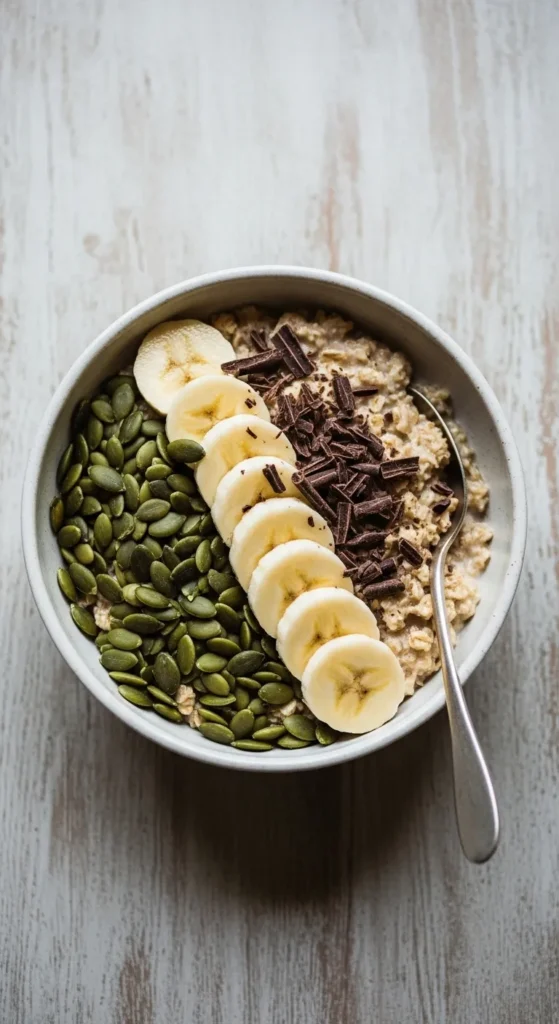
🍳 The No Meltdown Bowl : The Ultimate Magnesium-Rich After-School Meal
The 5-minute magnesium reset that turns the 3pm chaos window into a calm zone.
🔪 Equipment You’ll Need
| Equipment | Purpose | Budget-Friendly Alternative |
|---|---|---|
| 🥣 Small bowl | Assemble and serve the No Meltdown Bowl | Any cereal bowl works perfectly |
| 🥄 Measuring cups and spoons | Portion oats, seeds, and toppings accurately | Eyeball it after a few tries — this recipe is very forgiving |
| 🔪 Small knife and cutting board | Slice banana evenly | Kitchen scissors for soft fruit in a pinch |
🍽️Serves
1–2 children
⏱️Prep
5 min
🔥Cook
0 min
📈Total Magnesium
~185mg
🛒Ingredients
| Diet Type | Modification | Key Neuro Benefit |
|---|---|---|
| Nut-Free 🌻 | Recipe is naturally nut-free as written. Pumpkin seeds are seeds, not nuts — safe for most nut-free diets. Confirm with your child’s school policy. | Pumpkin seeds deliver zinc alongside magnesium, supporting steady dopamine regulation without any nut allergen risk. |
| Dairy-Free 🥥 | Replace Greek yogurt with unsweetened coconut yogurt or oat-based plain yogurt. For the liquid, use unsweetened almond milk or coconut milk — both are the preferred choice here anyway. | Removes casein, which can trigger low-grade gut inflammation in sensitive kids, ensuring maximum magnesium absorption through a calmer digestive tract. |
| Gluten-Free 🌿 | Use certified gluten-free oats (standard oats are often cross-contaminated). The rest of the recipe is naturally gluten-free. | Certified GF oats deliver the same steady glucose and magnesium load without triggering gut inflammation that would compete with mineral absorption. |
| Vegetarian 🫘 | Recipe is already 100% vegetarian as written. For extra plant-based protein, stir in 1 tbsp of hemp seeds — they add 3g protein and a bonus 27mg of magnesium per tablespoon. | Hemp seeds provide all 9 essential amino acids, including tryptophan — the direct precursor to serotonin — amplifying the calming effect of the bowl. |
| Low-Carb 🥒 | Replace oats with 3 tbsp of chia seeds soaked for 15 minutes. Top with avocado slices instead of banana. | Chia seeds deliver 95mg of magnesium per 30g — comparable to oats — while keeping net carbs minimal and adding omega-3 ALA for additional anti-inflammatory brain support. |
Total magnesium per bowl: ~152mg (51–67% of daily requirement depending on child’s age)
💡 The MiniChef Secret: Why We Don’t Use Cow’s Milk Here ?
Calcium and magnesium are rivals in your child’s digestive system. They compete for the exact same absorption transporters in the gut wall — and calcium almost always wins that race because it’s present in much higher quantities in cow’s milk.
If you serve this bowl with regular cow’s milk, your child’s body will absorb significantly less magnesium from all those carefully chosen ingredients. You’ve done the work — the pumpkin seeds, the oats, the banana — and the milk quietly cancels a good portion of it out.
The fix is simple: use unsweetened almond milk, coconut milk, or even plain water as your liquid here. Almond milk has virtually no calcium competition, and coconut milk adds a natural creaminess that kids love.
We want VIP magnesium absorption — no queue at the door.🎟️
👩🍳Instructions
Step 1 — Soak the oats (10–15 minutes or overnight) Combine the rolled oats and almond milk (or coconut milk) in a bowl. Let rest for 10–15 minutes at room temperature, or overnight in the fridge.
Why this matters ?
Oats contain phytic acid — a compound that binds to magnesium and blocks its absorption in the gut. Soaking activates natural enzymes that break down phytic acid, unlocking up to 100% of the magnesium stored in the oats. This single step is the difference between a bowl that looks healthy and one that actually delivers. Overnight soaking = maximum magnesium release.
Step 2 — Add the banana Slice the banana directly into the bowl and stir gently into the soaked oats.
Why banana works here ?
It delivers 32mg of magnesium, but its real superpower in this recipe is Vitamin B6 — the molecular “passport” that allows magnesium to cross from the bloodstream into nerve cells. Without B6, magnesium stays in circulation instead of reaching where it matters: inside the neuron. Banana + oats is a synergy, not a coincidence.
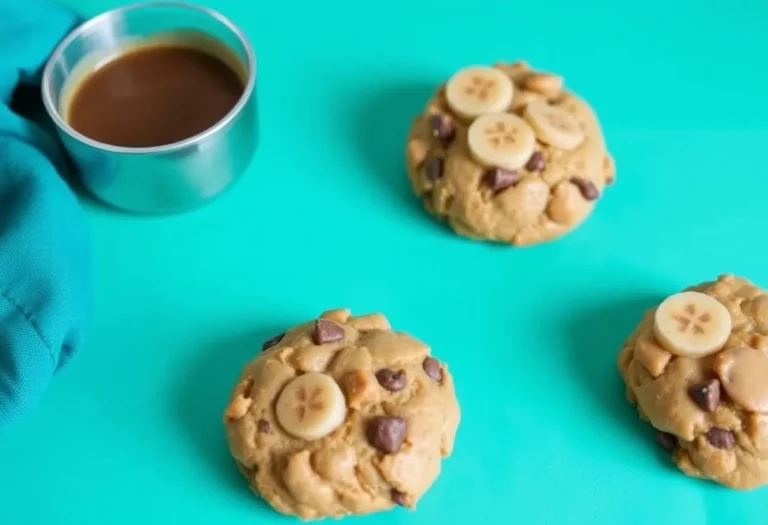
Step 3 — Add toppings Top with dark chocolate chips, pumpkin seeds, and a small drizzle of almond butter or sunflower seed butter. Add honey or maple syrup only if your child needs the extra palatability nudge — the banana already provides natural sweetness.
Step 4 — Serve immediately or refrigerate Serve at room temperature or chilled. If prepping for the week, prepare 5 jars on Sunday (without the chocolate chips and seeds on top — add those fresh at serving time to maintain crunch). Keeps refrigerated for up to 3 days.
5-minute assembly on school days. The hard work was Sunday.
No cooking. No blender. No dishes beyond one bowl.
🌟 The Bottom Line
The meltdown at 3:47 PM isn’t a character flaw. It’s a mineral gap — and you now have the tools to close it.
These seven magnesium rich foods for kids aren’t aspirational superfoods requiring a specialty grocery store and two free hours. They’re bananas, oats, and dark chocolate. They’re the avocado you already buy and the spinach you can hide in a smoothie.
The No Meltdown Bowl takes five minutes. The Sunday prep takes twenty. And the result — a child whose brain has the raw materials it needs to stay calm, stay focused, and handle the pressure of the school sprint without falling apart — is worth every one of those minutes.
Start with one food this week. Add another next week. That’s the MiniChef way: small steps, real results, no perfection required.
🎥Bonus
❓ FAQs
1. How quickly will magnesium-rich foods improve my child’s focus?
Blood glucose stabilization from oats happens within 30–60 minutes. Neurological effects from consistent magnesium intake — improved GABA regulation, reduced cortisol reactivity — build over 2–4 weeks of daily consumption. Most parents report noticing calmer after-school behavior within 7–10 days of consistent implementation.
2. Can my child get enough magnesium from food alone, or do they need supplements?
For most children eating a varied diet, magnesium rich foods are sufficient and preferable. The seven foods in this guide, combined consistently, can meet 80–100% of daily magnesium requirements without supplementation. If your child has diagnosed ADHD or significant attention challenges, consult your pediatrician about magnesium glycinate supplementation as a complement to dietary sources.
3. Is dark chocolate really safe for kids?
Yes — with two clear parameters: minimum 70% cacao, and a sensible portion (1–2 squares or 1 tablespoon of chips). Here’s why this matters beyond just “it’s a treat”:
At 70%+ cacao, dark chocolate delivers 64mg of magnesium per 30g serving — more than a serving of spinach. It also contains flavonoids that activate GABA receptors directly, which is why a small amount at 4 PM can genuinely contribute to the after-school calm you’re looking for.
On the caffeine question — because every parent asks: Two squares of 70%+ dark chocolate contain approximately 12–25mg of caffeine. For context, a cup of decaf coffee contains 10–15mg. You’re not wiring your child up. And here’s the part nobody mentions: the magnesium dose in those same two squares actively counterbalances any mild stimulation from the caffeine. The mineral and the molecule work in opposite directions — the magnesium wins at this dose.
What to avoid ?
milk chocolate (the magnesium content drops by 60–70% and the sugar load creates the blood glucose spike you’re specifically trying to prevent), and any chocolate marketed as “kids chocolate” which is almost always under 30% cacao with added sugars and fillers.
Two squares of real dark chocolate after school is not a compromise. It’s the snack working exactly as intended.
4. What if my child refuses all seven magnesium rich foods?
Start with bananas — virtually universally accepted. Then use the “sneak-it” strategy for spinach in smoothies and pumpkin seeds in oatmeal. Most children will accept 3–4 of these seven foods in familiar formats. You don’t need all seven. Even 2–3 consistent sources make a measurable difference.
5. Does cooking destroy magnesium in these foods?
Minimal cooking (steaming, light sautéing) preserves most magnesium. Boiling vegetables in large amounts of water causes the most significant loss — up to 30%. For spinach, blending raw into smoothies preserves 100% of magnesium content. For oats, the No Meltdown Bowl’s no-cook method eliminates this concern entirely.
6. Are these rich magnesium foods also good for kids without attention issues?
Absolutely. Magnesium supports healthy brain development, bone formation, sleep quality, and emotional regulation in all children — not just those with attention challenges. The foods on this list are foundational nutrition for every child, regardless of whether focus is a specific concern.
🧾Keep Exploring
MAGNESIUM is the calm foundation — but the brain runs on a full team of nutrients. Here’s where to go next.
Sources & References
Tucker JE, Brennan AM, Benton D, Young H. A Recipe for Resilience: A Systematic Review of Diet and Adolescent Mental Health. Nutrients. 2025;17(23):3677. doi:10.3390/nu17233677 — Covered by ScienceDaily, March 29, 2026.
Kozielec T, Starobrat-Hermelin B. Assessment of magnesium levels in children with ADHD. Magnesium Research. 1997;10(2):143–148. PubMed
Hemamy M et al. The effect of vitamin D and magnesium supplementation on the mental health status of ADHD children. BMC Pediatrics. 2021. PMC
Dr. Roseann Capanna-Hodge credentials verified at drroseann.com and NRBS registry, April 2026.
This article is for educational purposes only and does not constitute medical advice. Always consult your pediatrician before making significant dietary changes or considering supplementation for your child.


Very Interesting !
Of course! Magnesium is essential for everyone in the family.