Rainbow Veggie Pizza: The Brain-Boosting Family Dinner That Hides 6 Vegetables in Plain Sight
Rainbow Veggie Pizza is a nutrient-dense, brain-boosting meal designed to support pediatric cognitive development by “hiding” six essential vegetables within a kid-friendly format. This Focus Fueling recipe utilizes the synergy of phytonutrients—such as lycopene for neural protection and Vitamin C for dopamine synthesis—to enhance concentration and memory in growing children. Specifically engineered for picky eaters, this rainbow-colored dinner transforms high-authority nutritional science into a practical solution for busy families seeking to optimize their child’s brain health through whole-food ingredients.
Table of Contents
⏱️ Prep Time
15 min
🔥 Cook Time
20 min
🍽️ Servings
4
👶🧒Age
2+ years

Quick note from Noah 🧠:
Pizza night just got a serious upgrade. This isn’t “health food disguised as pizza.” It’s genuinely delicious pizza that happens to load your kid’s brain with the exact nutrients neuroscience says matter most for focus, mood, and learning. And it takes 35 minutes start to finish. Let’s do this.
🧠Why This Builds Brains ?
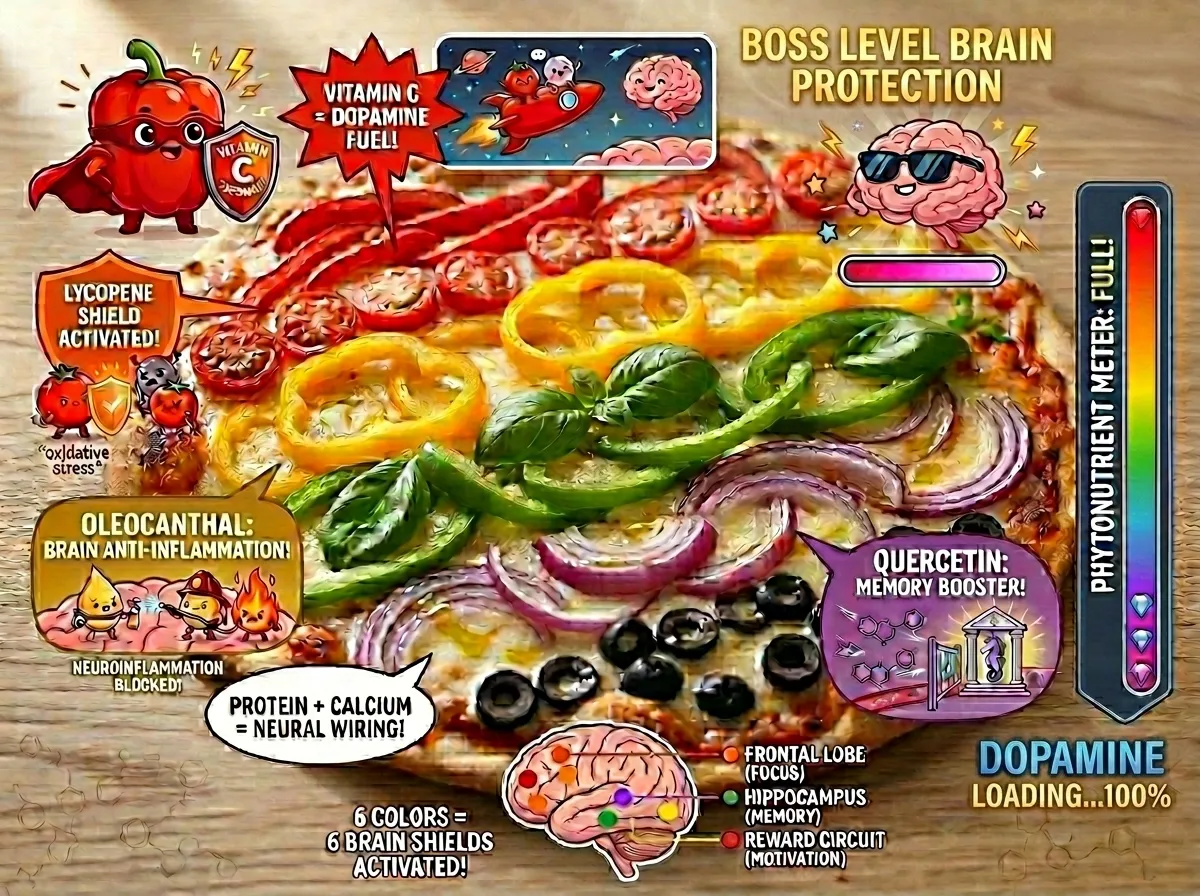
Here’s the thing most pizza recipes won’t tell you: the vegetables in this pizza aren’t just “healthy extras.” Each color on this pizza corresponds to a specific family of phytonutrients that your child’s developing brain genuinely needs.
Bell peppers (red, yellow, green) are one of the richest food sources of Vitamin C on the planet — gram for gram, more than oranges. Vitamin C is essential for synthesizing dopamine, the neurotransmitter responsible for motivation and reward. When kids’ dopamine regulation is healthy, homework battles get easier. That’s not a metaphor.
Red onion contains quercetin, a flavonoid that crosses the blood-brain barrier and has been shown to reduce neuroinflammation and support memory consolidation. You won’t taste it under the cheese. Your kid’s hippocampus will thank you anyway.
Cherry tomatoes deliver lycopene, a fat-soluble antioxidant that protects neural cell membranes from oxidative damage. The olive oil drizzle in this recipe is not decorative — it’s necessary for lycopene absorption.
Olive oil provides oleocanthal, a compound with documented anti-inflammatory effects comparable to low-dose ibuprofen, specifically in brain tissue. Chronic low-grade neuroinflammation is increasingly linked to attention difficulties in children.
Black olives add another hit of monounsaturated fats and polyphenols that support the myelin sheaths wrapping your child’s neurons — essentially the insulation on the brain’s wiring.
Fresh basil contains eugenol and rosmarinic acid, compounds with demonstrated antioxidant and neuroprotective activity.
The research on dietary patterns and pediatric cognitive development is clear: variety of plant pigments = variety of protective phytonutrients. This pizza delivers six distinct colors. That’s six different brain-protective mechanisms, on one crust, in one meal your kids will actually eat.
💬 Expert Perspective
“Vitamin A provides antioxidants that help protect children from developing chronic diseases. It’s found in many of the things that give color to your child’s world. Kids who eat diets high in this vitamin, especially from plant-based sources, live longer and have fewer illnesses. The vegetable group represents a blend of both retinoids and carotenoids for your child and are also pleasing to the palate and a beautiful addition to any meal.”
— Jill Castle, MS, RDN — Pediatric Dietitian, Former Clinical Nutritionist at Boston Children’s Hospital, Author & TEDx Speaker. Founder of The Nourished Child® — Vitamin A for Kids: Benefits, Sources, and Supplementation
🛒Ingredients
| Ingredient | Quantity |
|---|---|
| Pizza dough | 1 ball |
| Tomato sauce | 1 cup |
| Mozzarella cheese, shredded | 2 cups |
| Red bell pepper, sliced | 1 |
| Yellow bell pepper, sliced | 1 |
| Green bell pepper, sliced | 1 |
| Red onion, sliced | 1 |
| Cherry tomatoes, halved | 1 cup |
| Black olives, sliced | 1/2 cup |
| Fresh basil leaves | 1/4 cup |
| Olive oil | 2 tablespoons |
| Salt and pepper | to taste |
Why these specific quantities matter: The 3-pepper combination isn’t random. Red peppers have the highest Vitamin C content (achieved through full ripening), yellow peppers lead in Vitamin B6, and green peppers have the highest concentration of chlorophyll-related compounds. Together, they cover more nutritional ground than any single pepper could alone.
🥗 Dietary adaptations
| Diet | Simple Swap |
|---|---|
| Vegan | Replace mozzarella with cashew cheese or store-bought vegan mozzarella |
| Dairy-free | Use dairy-free cheese or skip cheese + add avocado slices after baking |
| Gluten-free | Swap pizza dough for a certified GF cauliflower crust or GF store-bought dough |
| Nut-free | Recipe is already nut-free as written |
| Low-sodium | Use no-salt-added tomato sauce and reduce olives to 1/4 cup |
| Higher protein | Add 1/2 cup white beans under the cheese layer or top with a soft egg (last 5 min) |
Important: Cauliflower crusts are not nutritionally equivalent to whole-grain crusts — they’re lower in fiber and B vitamins. If you’re using them for convenience, consider a whole-grain pita alternative for older kids to maintain the dietary fiber load.
🔪 Equipment You’ll Need
No special gear required here — this is intentionally a low-barrier recipe. Here’s what you’ll actually use:
| Tool | Why You Need It | Budget-Friendly Alternative |
|---|---|---|
| Baking sheet (rimmed, half-sheet) | Catches drips, ensures even heat distribution | Any oven-safe flat pan works |
| Pizza stone (optional) | Creates a crispier bottom crust by absorbing moisture from the dough | Not necessary — baking sheet gives great results |
| Rolling pin | Rolls dough to even thickness | A clean wine bottle works perfectly |
| Pizza cutter | Clean slices without dragging toppings | A large sharp knife does the job |
| Cutting board | Prepping all vegetable toppings | |
| Chef’s knife | Slicing peppers, onion, olives | |
| Mixing bowl | Holding prepped toppings during assembly |
One worthwhile investment: If you make pizza more than twice a month, a pizza stone genuinely improves results — the crust gets crispier on the bottom and cooks more evenly. A basic ceramic stone runs under $30 and lasts years. Not essential today, but worth knowing about.
👩🍳Step-by-Step Instructions
Step 1 — Preheat and Prep (5 min)
Preheat your oven to 450°F (230°C). While it heats, roll out the pizza dough on a lightly floured surface to your desired thickness. Thinner = crispier; thicker = chewier and more bread-like (toddlers often prefer thicker).
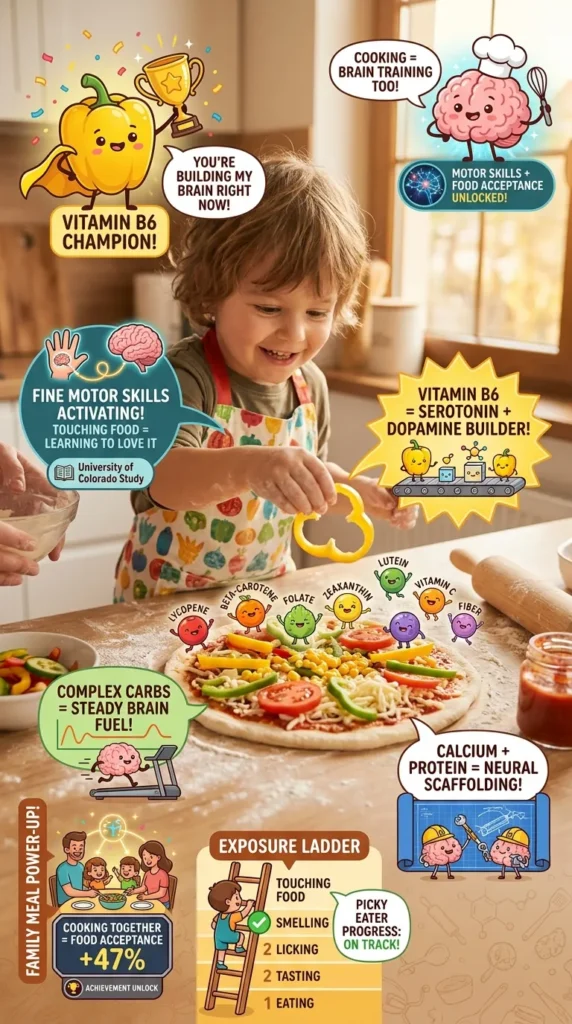
🧠 Brain tip: Get the kids to help here. Rolling dough develops fine motor skills and the sensory experience of dough texture actually supports interoceptive awareness in young children.
Step 2 — Base Layer (3 min)
Transfer dough to a baking sheet or pizza stone. Spread the tomato sauce evenly over the surface, leaving a 1/2-inch border. Sprinkle the shredded mozzarella across the sauce in an even layer.
Why not skip the sauce? Tomato sauce is a concentrated source of lycopene — cooking tomatoes actually increases lycopene bioavailability compared to raw. This is one of the few cases where processed (cooked) is genuinely better than fresh for nutrient absorption.
Step 3 — The Rainbow Topping (5 min)
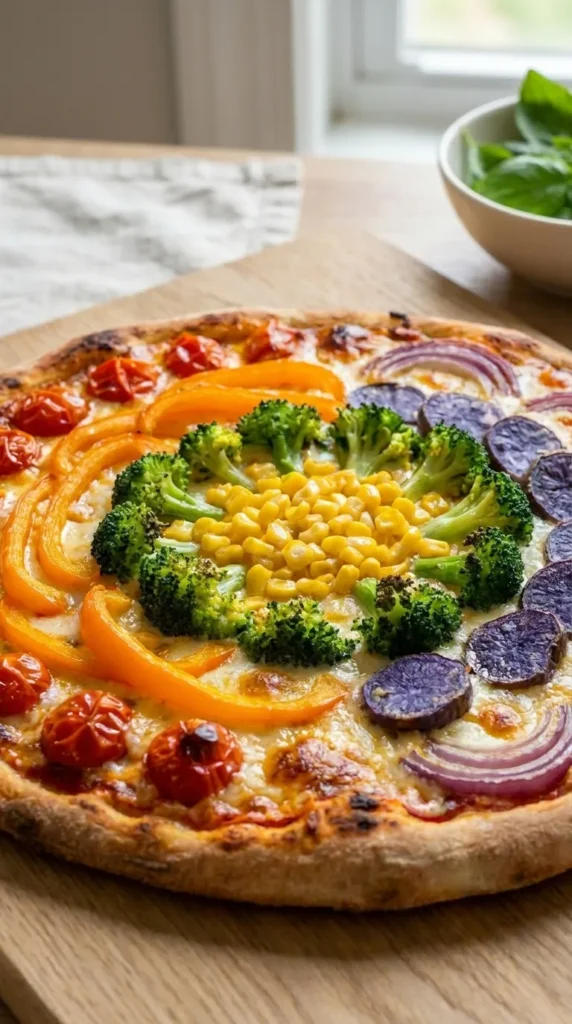
This is where it gets visual — and where kids become invested. Arrange the vegetables in color sections if you want the classic “rainbow” look, or let kids scatter them freely. Either works nutritionally. The rainbow arrangement just tends to get more excited reactions at the table.
Place the red bell pepper slices, yellow bell pepper slices, green bell pepper slices, red onion rings, cherry tomato halves, and black olive slices on top of the cheese. Drizzle with olive oil. Season with salt and pepper.
Step 4 — Bake (15–20 min)
Bake in the center of the preheated oven for 15–20 minutes, until the crust is golden brown and the cheese is bubbling with light golden spots. Avoid the top rack — it will burn the vegetables before the crust cooks through.
Visual cue for doneness: The cherry tomatoes will have released their juices and slightly collapsed. That’s your signal the internal temperature is right.
Step 5 — Finish and Serve
Remove from the oven. Immediately scatter the fresh basil leaves over the top (heat wilts them slightly and releases their volatile oils — this is when the flavor is best). Slice and serve warm.
👶How to Serve by Age
18 months – 2 years: Cut into tiny pieces (1 cm cubes). Remove whole olive slices and chop finely. The cheese and soft-baked vegetables are ideal texture for this age. Skip added salt when making for under-2s.
2–4 years: Small triangles or strips work well. Let them pick up pieces with their hands — this age group is still developing palmar grasp and self-feeding is important. Expect toppings to be removed and that’s fine; the sauce still delivers lycopene.
4–7 years: Standard pizza slices. This is prime age for the “you choose your own toppings” approach (see Picky Eater Strategy below). Encourage them to name the colors — it builds food vocabulary and positive associations simultaneously.
7–12 years: Full slices. Involve them in the full recipe at this stage — measuring, spreading sauce, arranging toppings. Kids who cook are statistically more willing to eat varied foods. That’s not folklore; it’s replicated in pediatric nutrition research.
Teens: Make it a customizable “pizza bar” — set out all the toppings in separate bowls and let them build their own. Autonomy over food choices at this age is developmentally appropriate and reduces food conflict.
😤Picky Eater Strategy
Let’s be honest about something: “just put vegetables on it and they’ll eat it” doesn’t always work. Here’s what actually does.
The Deconstructed Offer. Set out the toppings before the pizza goes together. Let your picky eater touch, smell, and arrange one vegetable of their choice onto their section of the pizza. This isn’t a negotiation — it’s building familiarity. Research shows that repeated exposure without pressure is the most effective method for expanding children’s food acceptance. One topping this week. Maybe two next week.
The “cheese wall” technique. For kids who reject visible vegetables: lay vegetables under the cheese layer on half the pizza. Once baked, they’re invisible and the texture is softer. As acceptance grows, gradually move toppings back on top.
The color game. Before eating, challenge your child to spot all 6 colors. Name them. This is genuine engagement with the food before it goes in their mouth — it disrupts the automatic rejection response.
What to avoid: pressure, bribes (“eat your pepper and you’ll get dessert”), and negative commentary about food preferences. These reliably backfire and create longer-term food aversion. Complexity kills execution — keep it light, keep it playful.
🔄Variations
| Variation | Changes | Brain Bonus |
|---|---|---|
| Pesto Base | Replace tomato sauce with basil pesto | Extra vitamin K from basil (bone + brain health) |
| Spicy Version (adults/older kids) | Add red pepper flakes to tomato sauce | Capsaicin shown to support cerebral blood flow |
| Greek Twist | Add crumbled feta + baby spinach + artichoke hearts | Iron from spinach supports oxygen delivery to brain |
| White Pizza | Replace tomato sauce with ricotta + garlic | Higher protein base; ricotta adds choline for memory |
| Egg-Topped | Add 1–2 cracked eggs in last 7 min of baking | Eggs = complete amino acid profile for neurotransmitter synthesis |
| Anchovy Boost | Add 4–5 anchovy fillets under cheese | Omega-3 DHA delivery without a fishy flavor after baking |
🧊Meal Prep & Storage
The Sunday 30-minute prep strategy: This pizza fits beautifully into a weekly prep routine. On Sunday, prep all the vegetable toppings in advance — slice all three bell peppers, halve the cherry tomatoes, slice the red onion and olives, and store them together in a single airtight container in the fridge. They’ll keep for 4 days. On pizza night, you’re looking at 5 minutes assembly + 20 minutes baking. That’s it.
Refrigerator storage: Leftover pizza keeps for up to 2 days in an airtight container. Reheat in a 375°F oven for 5–7 minutes (not the microwave — microwave ruins the crust texture, and texture matters for kids’ willingness to eat leftovers).
Freezer storage: Bake, cool completely, slice, and freeze in a single layer on a baking sheet. Transfer to a freezer bag once frozen solid. Keeps for up to 1 month. Reheat from frozen at 400°F for 10–12 minutes directly on the oven rack (crisps the bottom crust back up).
| Storage | Duration | Best Reheating Method |
|---|---|---|
| Refrigerated | Up to 2 days | 375°F oven, 5–7 min |
| Frozen | Up to 1 month | 400°F oven from frozen, 10–12 min |
Prep for school lunch: Let pizza cool completely before refrigerating. Cold pizza slices (with toppings held underneath the cheese) travel well in lunchboxes and are often more accepted by school-age kids than warm leftovers.
🧠Nutrition at a Glance
| Nutrient | Per Serving | Why It Matters for Brain |
|---|---|---|
| Calories | 350 kcal | Sustained energy for afternoon focus |
| Total Fat | 15g | Required for fat-soluble vitamin absorption |
| Protein | 15g | Amino acid substrate for neurotransmitters |
| Carbohydrates | 40g | Primary fuel source for growing brains |
| Fiber | 5g | Feeds gut microbiome → gut-brain axis support |
| Iron | 10% DV | Oxygen transport to neural tissue |
| Vitamin A | 20% DV | Retinal + cognitive development |
| Vitamin C | 30% DV | Dopamine synthesis co-factor |
🎥Added Bonus
🧾Keep Exploring
If this rainbow pizza is a hit at your table, here’s where to go next — each post follows the same brain-first philosophy: real food, real science, real families.
More Brain-Boosting Dinners:
- Mediterranean Vegetable Pizza — Same veggie-first approach, different flavor profile. Feta, spinach, and artichoke hearts bring iron and B12 to the party.
- Creamy Butternut Squash Mac and Cheese — The brain-boosting trojan horse of comfort food. Beta-carotene hidden in the sauce. Kids never know.
- Zucchini Casserole Dinner — Golden, cheesy, and naturally gluten-free. Only 8g carbs per serving, and it reheats beautifully for school lunch the next day.
If your kid is a texture-first eater:
- Sweet Potato and Black Bean Quesadilla — Soft, familiar format with serious nutritional depth. Great bridge recipe for picky eaters who struggle with mixed textures.
For the science-curious parent:
- Foods to Help Kids Focus — The research-backed breakdown of which nutrients actually move the needle on attention and learning. If you want to understand why these recipes work, start here.
🧑The Bottom Line
You don’t need a perfect dinner. You need a consistent one.
Rainbow Veggie Pizza isn’t a magic bullet for brain development — no single recipe is. But it represents exactly the kind of meal that adds up over time: six plant colors, quality fat, adequate protein, and enough visual fun to get kids genuinely interested in what’s on their plate. Done in 35 minutes. Adaptable for every dietary need at the table. Freezer-friendly for the weeks when life doesn’t cooperate.
The research on pediatric nutrition and cognitive outcomes is consistent: it’s the pattern that matters, not the perfect meal. This pizza is a pattern-builder. Make it once, adjust it to your family’s taste, put it in the rotation. That’s the whole strategy.
And if your picky eater only eats the cheese tonight? That’s fine. The sauce still delivered lycopene. The olive oil still crossed the blood-brain barrier. You still cooked. That counts.
Pin this for your next pizza night 🍕 — and tag us when your kids argue over who gets to arrange the rainbow toppings.
❓FAQs
Is pizza actually healthy for kids?
It can absolutely be, and this version demonstrates exactly why. The nutritional profile of a meal depends on what’s in it, not what category it belongs to. This pizza delivers protein, complex carbohydrates, dietary fiber, healthy fats, and a meaningful dose of vitamins A and C in a single serving. The key variables are the quality of the crust (whole grain is preferable), the sauce (low-sodium, no added sugar), the cheese (used in reasonable amounts), and the toppings. Loaded with vegetables and drizzled with olive oil, this is a genuinely balanced family meal.
How do I get my picky eater to eat vegetables on pizza?
Start with involvement, not confrontation. Let your child choose one topping to add themselves before the pizza goes in the oven. Even just touching and placing the food creates familiarity. If vegetables on top are rejected, try placing them under the cheese layer — once baked, they’re invisible and the texture softens considerably. Research from the University of Colorado confirms that repeated exposure without pressure is the most effective strategy for expanding food acceptance in children. One small vegetable win per week is meaningful progress.
Can I use store-bought pizza dough?
Yes, and you should if it saves you time. Whole-wheat store-bought dough adds fiber and B vitamins. Fresh dough from a grocery store bakery section is another excellent option. The goal is getting this meal on the table — a bought crust with rainbow vegetable toppings is infinitely better than no vegetables at dinner.
What’s the best cheese for kids’ pizza?
Part-skim mozzarella is the standard for good reason: it melts well, has a mild flavor that kids accept easily, and provides calcium and protein without excess saturated fat. If you want to reduce sodium, fresh mozzarella torn by hand (rather than pre-shredded, which contains anti-caking agents) is a cleaner option. For dairy-free families, cashew-based mozzarella melts reasonably well and has a similar flavor profile.
Can I make this pizza gluten-free?
Yes. Use a certified gluten-free pizza dough (store-bought GF dough works well, as does a cauliflower crust for a lower-carb option). Note that cauliflower crusts have a different texture — they’re more delicate and won’t support heavy topping loads as well as traditional dough. For the best texture on a GF cauliflower base, pre-bake it for 10 minutes before adding sauce and toppings.
At what age can babies eat pizza?
Most pediatric nutrition guidelines suggest that pizza with a soft, well-cooked crust is appropriate from around 12–18 months, once your child is established on varied solid foods. Key modifications for under-18-months: skip added salt (don’t season with salt or use a low-sodium sauce), cut into very small pieces to prevent choking, and ensure the cheese is soft and not stringy. For babies under 12 months, consult your pediatrician before introducing wheat-based foods if there’s a family history of gluten sensitivity.
How many vegetables should kids eat per day?
The USDA Dietary Guidelines for Americans recommend 1–1.5 cups of vegetables daily for children ages 2–3, 1.5–2 cups for ages 4–8, and 2–3 cups for ages 9–18. One serving of this Rainbow Veggie Pizza provides approximately 1–1.5 cups of vegetables, making it a genuinely significant contribution toward daily targets in a single meal.