Brain Food for Kids: Why Salmon, Mackerel & Sardines Deserve a Spot on Your Table
You’re already doing a lot. Packed lunches, bedtime negotiations, the “I don’t like it” standoff at 6:30 p.m. The last thing you need is another nutrition rule that feels like homework.
So this post is on your team. No guilt, no perfect-parent checklist. Just one simple habit, backed by real research, that you can start with a single can.
Because here’s what we’ve learned: complexity kills execution. A plan you can actually do on a Tuesday beats a perfect plan you’ll never start.
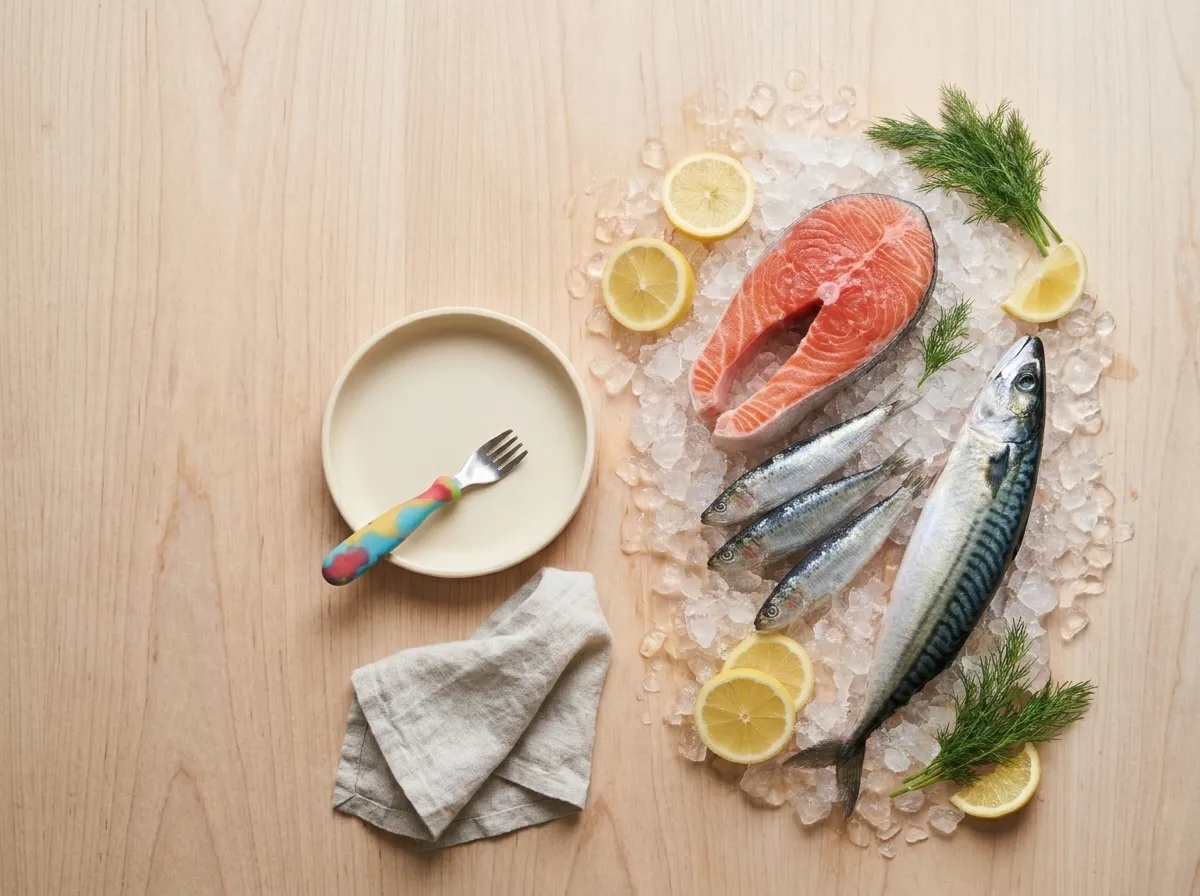
Quick answer : The best brain food for kids that fits a real weeknight is oily fish: salmon, mackerel and sardines (nutrition folks call them the “SMASH” fish, along with anchovies and herring). The FDA suggests two small servings a week from its low-mercury “Best Choices” list. Canned counts.
Table of Contents
🌿 Our #1 Rule: Go Natural
Before any recipe, one rule we hold firmly: for your kids, choose wild-caught salmon over farmed whenever you can, and choose real, minimally processed foods across the whole plate.
Here’s why, in plain terms. These are the concerns about farmed salmon that hold up in the research:
- Contaminants. Farmed salmon is fattier and builds up PCBs from its feed. A benefit-risk analysis in The Journal of Nutrition found a better ratio for wild Pacific salmon overall, and said young children can limit exposure by choosing the least contaminated wild salmon or other omega-3 sources. Levels differ a lot by region.
- Antibiotics. Use depends on the country. Chile, the world’s second-largest producer, relies on far more than Norway or the US: one review counts 16 antibiotics in use there, against 3 in the US and 4 in Norway. Scientists are still working out what that means for antibiotic resistance. Wild-caught fish sidestep the question.
What we did not find ?
Reliable evidence that farmed salmon is raised with growth hormones. NOAA material says the FDA prohibits them in food fish, and we found no independent study showing otherwise. That worry belongs mostly to beef, so we won’t ask you to fear it.
The honest nuance: some farmed salmon in that analysis scored close to wild, and the FDA’s fish chart doesn’t separate wild from farmed. So this is our precaution, not a medical rule, and farmed salmon still beats no fish at all.
How to do it without wrecking your budget or your week ?
- Look for “wild-caught” (or “wild Alaskan”) on the label. “Atlantic salmon” at the counter is usually farmed.
- Canned wild salmon, sardines and mackerel are usually the most affordable wild options, and canned counts.
- Same principle for the rest of the plate: fresh or frozen fish, plain canned fish, eggs, whole fruit and whole grains beat processed, sugary versions. Dietitians warn that processed foods high in sugar or trans fats can hurt memory and concentration.
🧠 Why This Builds Brains
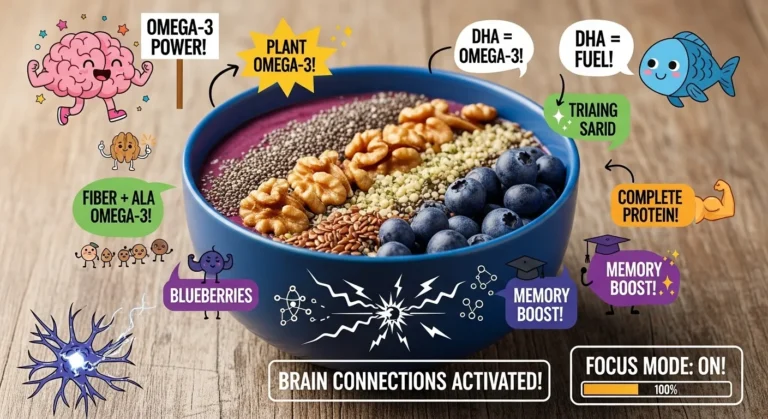
Your child’s brain is working overtime. According to dietitians at Singapore’s KK Women’s and Children’s Hospital, the brain is more than 50% fat, and 25–35% of that fat is DHA, an omega-3 found in cold-water fish.
Think of DHA as part of the building material for the connections between brain cells, and kids are building those connections at full speed. Our bodies convert only small amounts of DHA from plant omega-3s, so ready-made DHA has to come mostly from food. Oily fish is the best source.
But omega-3s are only half the story. The FDA points out that fish also bring choline, iron, zinc, vitamin B12, vitamin D, iodine and selenium. It’s a nutrient package deal, and sardines eaten with their soft bones add calcium too.
🔬 What the Research Actually Says (The Honest Version)
You’ll see big claims online: “+7 IQ points!” “An extra hour of sleep!” You deserve the real numbers, so here they are.
| What you’ll hear | What the studies found | How solid is it? |
|---|---|---|
| “Kids who eat fish score higher on IQ tests” | In a University of Pennsylvania study of 541 Chinese children aged 9–11, weekly fish eaters scored 4.8 points higher than kids who rarely ate fish, and slept better. | Observational: a link, not proof of cause |
| “Fish adds 7.7 IQ points” | A systematic review found an average 7.7-point gain in studies that reported benefits when mothers ate seafood during pregnancy. | About pregnancy, not kids’ dinners; average of positive studies |
| “Low-fish diets hold kids back” | In Bristol’s Children of the 90s (about 9,000 pregnancies), children of mothers who ate no fish were more likely to have low verbal IQ at age 8. | Observational |
| “Omega-3 pills make kids smarter” | Mixed. A 2014 meta-analysis of randomized trials found no gains in memory, executive function or processing speed in children (attention aside). A 2020 review suggests results may depend on a child’s omega-3 blood level. | Mixed evidence |
| “Omega-3 adds an hour of sleep” | In Oxford’s DOLAB trial, 600 mg of algal DHA daily for 16 weeks was linked to 58 more minutes of sleep, but in a small subgroup of 43 poor sleepers; parent questionnaires showed no significant effect. | Small pilot study |
The bottom line: fish is a smart, low-effort nutrition habit with encouraging links to sleep and learning. It is not a magic IQ pill, and it doesn’t need to be. You’re stacking the odds in your child’s favour, not sitting an exam.
The researcher behind that 4.8-point finding has a simple message for parents:
“Children should be introduced to it early on.”
Source: University of Pennsylvania, “Weekly Fish Consumption Linked to Better Sleep, Higher IQ”
Jianghong Liu, University of Pennsylvania researcher behind the fish, IQ and sleep study
Her study is observational, so it shows a link, not proof of cause, but the advice costs nothing to follow. The Penn release says “early” can mean from about 10 months (boneless, finely chopped) and by age two.
Update to our earlier salmon post: we shared larger portion sizes and a “7.7 IQ points” figure there. The current FDA serving sizes are below, and the 7.7 figure relates to pregnancy, as explained above.
🐟 Meet the SMASH Fish
| Fish | EPA + DHA per 3 oz (approx.) | FDA category | Taste for kids | Easiest way in |
|---|---|---|---|---|
| Salmon (wild-caught) | ~1.2 to 1.6 g | Best Choice | Mild, buttery | Flaked into rice, patties, pasta |
| Sardines (canned) | ~1.2 g | Best Choice | Strong; soft edible bones | Mashed into tomato sauce |
| Atlantic mackerel | ~1.0 g | Best Choice | Rich, bold | Lemon-yogurt mash on toast |
Omega-3 values are approximate and vary by species, brand, season and preparation (sardine and mackerel figures: USDA data via Today’s Dietitian). Farmed Atlantic salmon has more, about 1.8 g per 3 oz, because it is fattier; see “Our #1 Rule” for why we still choose wild.

🎯 Note :
“Careful with ‘mackerel.’ Not all mackerel are equal. Atlantic and Pacific chub mackerel are FDA “Best Choices.” Spanish mackerel is a “Good Choice” (one serving a week), and king mackerel is on the “avoid” list because of its mercury level. Check the species on the label.”
👶 How to Serve by Age (FDA Portions)
The FDA/EPA advice for children is 2 servings a week from the “Best Choices” list, with portions sized to age:
| Age | One serving |
|---|---|
| 🍼 1–3 years | about 1 oz |
| 🧒 4–7 years | about 2 oz |
| 🏫 8–10 years | about 3 oz |
| 🎒 11 years | about 4 oz |
For scale: 4 ounces is roughly the size of an adult palm. For “big kids” (ages 8 to 11), portions step up to 3 to 4 ounces, so one can of salmon can cover a school-age child and a younger sibling.
Under 1? After a fish allergy has been ruled out with your pediatrician’s guidance, pediatric feeding experts suggest strips of canned fish about the size of two adult fingers, or flaked fish mixed into soft foods. Choose low-sodium options when you can.
🥚 The Best Brain Foods for Kids (Beyond Fish)
Fish is a star, not the whole show. No single food builds a brain, so think of the best brain foods for kids as a pattern you repeat, not a checklist you pass or fail.
- Dark leafy greens: neuroscientist Lisa Mosconi told National Geographic that if she had to pick one food for children’s brain health, this would be it. Blend or mash them into sauces, like the spinach in our pasta below.
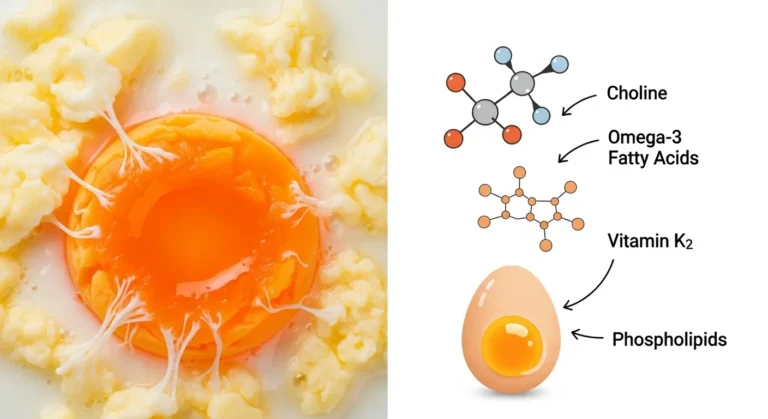
- Eggs: a quick, familiar food that dietitians list among brain-supportive options. Easy at breakfast.
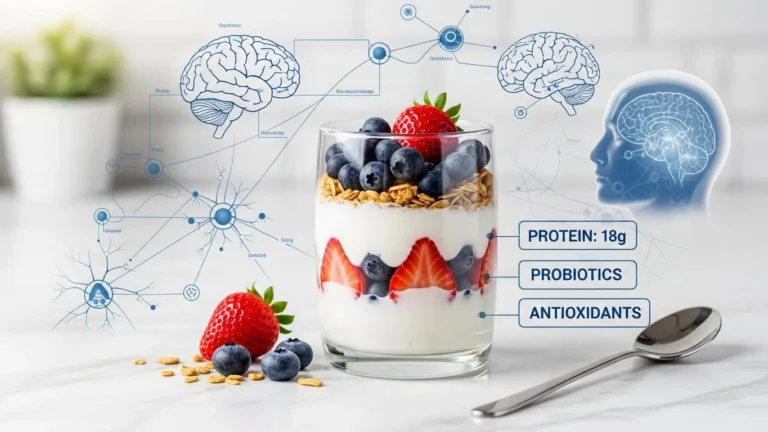
- Berries: blueberries show up on pediatric dietitians’ brain-food lists, and frozen ones work just as well for a busy week.
- Whole grains and oats: they release energy steadily, so the brain isn’t running on empty by mid-morning.
- Breakfast itself: Children’s National notes that eating breakfast is linked to better concentration, mood and behavior.
😤 Picky Eater Strategy: The Low-Drama Ladder
Fish smells strong. Kids notice. Here’s a ladder you can climb at your child’s pace, with no pressure and no pleading.
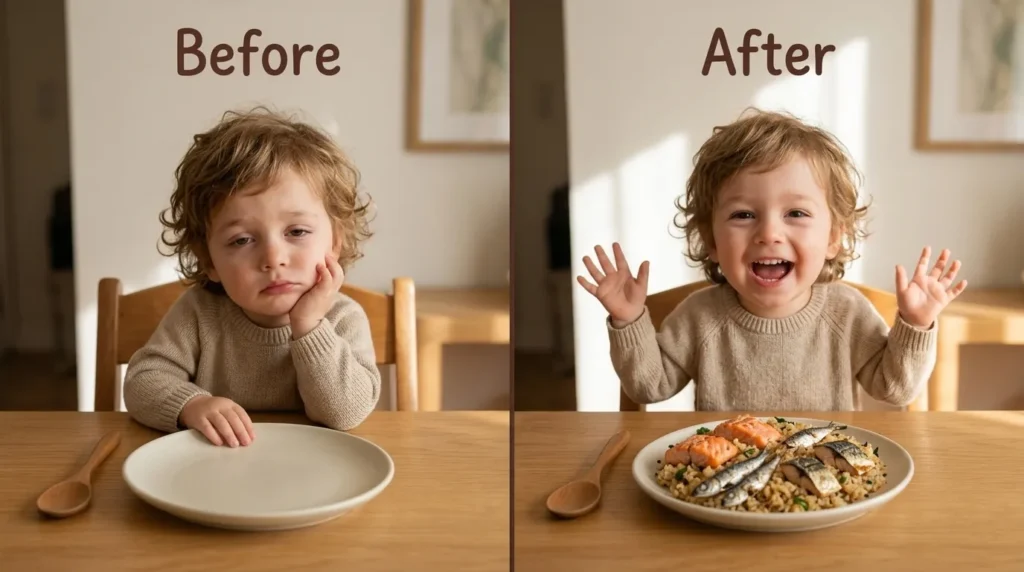
- Start mild. Salmon first. It’s the “gateway fish.”
- Hide it in something familiar. Pasta sauce, patties, rice bowls. Fish that disappears into a favourite is a win.
- Give them a job. Grating the carrot, squeezing the lemon, choosing the dip. Kids who help cook are more willing to taste.
- Let it show up. Small flakes on toast or a bowl of rice, next to a “safe” food.
- Repeat, calmly. If it’s refused, say nothing and serve it again next week. A refusal today isn’t a verdict.
A registered dietitian who has worked on salmon baby food agrees that early matters:
“…children’s food preferences are largely developed by the time they’re 5…”
Source: University of Illinois News Bureau, “Salmon baby food? Babies need omega-3s and a taste for fish”
Susan Brewer, professor of food science and registered dietitian, University of Illinois
Two bonus moves: add a squeeze of lemon (acidity balances strong fish flavours), and eat it yourself. National Geographic’s brain-food coverage puts it simply: kids learn from watching their parents.
⏱️ Sunday Prep: 30 Minutes, Three Jobs
Guilt says cook fish from scratch every night. Reality says no. Try this:
- 10 min: Bake and flake. Bake two wild-caught salmon fillets (about 12–15 minutes at 400°F / 200°C), flake, and refrigerate for up to 2 days. Instant add-in for rice bowls, quesadillas and omelettes.
- 10 min: Mash a spread. Make the mackerel mix from the bonus recipe below and keep it in a jar for 2 days.
- 10 min: Make the sauce base. Cook the sauce for the recipe below (through Step 3) and freeze in portions.
That’s a week of “two servings” covered with one half-hour and a couple of cans. Prefer a salmon-only dinner? Try our Salmon Fish Cakes.
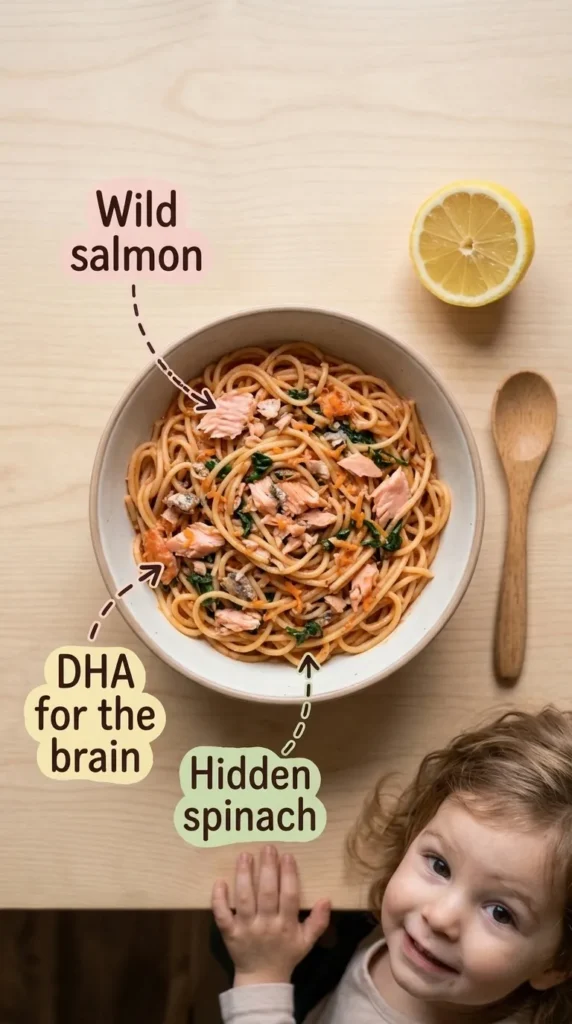
🍳 The Recipe: Kid-Friendly Salmon & Sardine Pasta (Secret-Agent Sea Pasta)
A rosy tomato sauce where the fish quietly disappears, and one of the easiest salmon recipes for kids we know. 🍽️ Serves 4 · ⏱️ Prep 10 min · 🔥 Cook 15 min · Total 25 min
🛒 Ingredients
- 8 oz (225 g) spaghetti or short pasta
- 1 tablespoon olive oil
- 1 small onion, finely chopped
- 1 medium carrot, finely grated
- 1 garlic clove, minced
- 1 cup (240 ml) tomato passata, no salt added
- 1 can (3.75 oz / 106 g) sardines in olive oil, drained
- 1 can (5 oz / 142 g) wild-caught pink salmon, drained and flaked
- 1 cup (30 g) baby spinach, finely chopped
- 1 teaspoon lemon juice
- 2 tablespoons grated Parmesan (optional)
🔪 Equipment : large pot, large skillet, box grater, wooden spoon, colander
👩🍳 Instructions
- Boil the pasta in a large pot of water according to the package directions. Reserve 1/2 cup (120 ml) of the cooking water, then drain.
- While the pasta cooks, warm the olive oil in a large skillet over medium heat. Add the onion and carrot and cook for 5 minutes, stirring, until soft.
- Stir in the garlic for 30 seconds, then add the pasta. Simmer gently for 5 minutes.
- Add the sardines and salmon. Mash everything with the back of a wooden spoon until the fish melts into a smooth, rosy sauce. Mash more for picky eaters; leave chunks for confident ones.
- Fold in the spinach and lemon juice and cook for 1 minute until the spinach wilts.
- Toss the pasta with the sauce, adding splashes of the reserved cooking water to loosen. Sprinkle with Parmesan if using. Let it cool to a safe temperature before serving.
Shopping tip: look for “wild-caught” on the salmon can, and sardines packed in olive oil with a short ingredient list.
Fish per serving: roughly 1¾ oz, so a half portion covers the 1-oz serving for ages 1–3. Estimated EPA + DHA: around 600–800 mg per serving (an estimate that varies by brand).
🥗 Dietary Adaptations
| Need | Swap |
|---|---|
| Gluten-free 🌿 | Use gluten-free pasta or serve over rice |
| Dairy-free 🥥 | Skip the Parmesan |
| Lower sodium 🧂 | Keep passata “no salt added”; choose sardines in olive oil and drain well |
| Extra veg 🥕 | Add finely grated zucchini with the carrot |
| Fish allergy ⚠️ | Not suitable. Talk to your pediatrician or allergist |
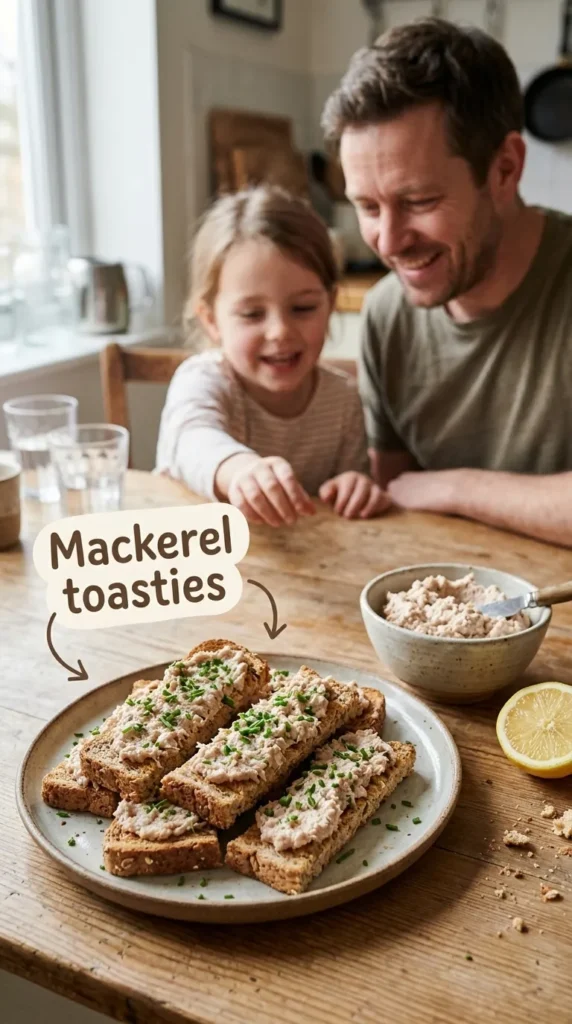
🥪 Bonus Recipe: Lemon-Yogurt Mackerel Toasties
The no-cook way into mackerel. 🍽️ Serves 3 · ⏱️ Prep 5 min · 🔥 Cook 0 min
🛒 Ingredients
- 1 can (4 oz / 113 g) Atlantic or Pacific chub mackerel in olive oil or water, drained, skin and large bones removed
- 2 tablespoons plain whole-milk yogurt
- 1 teaspoon lemon juice
- 2 tablespoons finely grated cucumber, squeezed dry
- 1 teaspoon finely chopped chives (optional)
- 4 slices whole-grain bread, toasted and cut into fingers
🔪 Equipment
- small bowl
- fork
- box grater
👩🍳 Instructions
- Mash the mackerel with a fork in a small bowl until fairly smooth.
- Stir in the yogurt, lemon juice, cucumber and chives.
- Spread on the toast fingers and serve right away.
Shopping tip
choose no-salt-added or water-packed cans, and check the species : Atlantic or Pacific chub, never king mackerel. One batch is about one 3-oz serving of fish, so share it.
Swaps
gluten-free bread; coconut yogurt for dairy-free.
❓ FAQs
Is salmon good for kids’ brains?
Salmon is rich in DHA and EPA, omega-3 fats that are part of brain tissue, plus choline, iron, zinc, B12 and vitamin D. Research links weekly fish to better sleep and test scores in school-age kids, though much of it is observational. Think “smart habit,” not magic pill.
How often should kids eat fish?
The FDA and EPA recommend two servings a week from the “Best Choices” list, sized for age: about 1 ounce for ages 1–3, 2 ounces for ages 4–7, 3 ounces for ages 8–10 and 4 ounces at age 11.
Can toddlers eat sardines?
Yes. Sardines are a low-mercury “Best Choice.” Canned ones have soft bones that mash easily. Choose olive oil or water packs, look for low sodium, drain well and offer small flaked or mashed portions. Check with your pediatrician first if there’s a family history of fish allergy.
Is mackerel safe for kids?
Atlantic and Pacific chub mackerel are FDA “Best Choices.” Spanish mackerel is a “Good Choice” (one serving a week), and king mackerel is on the avoid list because of high mercury. Check the species on the label.
Do kids need omega-3 supplements?
Food comes first. Reviews of supplement trials are mixed: a 2014 meta-analysis found no cognitive boost in children apart from attention, and Mayo Clinic says supplements seem to have little effect on cognitive ability and school performance in healthy school-age children. The picture looks more encouraging for children with ADHD. If your child won’t eat fish, ask your pediatrician about an algal-oil or fish-oil supplement.
What is the best brain food for kids?
No single food does it all. Oily fish, eggs, leafy greens, berries and whole grains together build a brain-friendly pattern. Fish is the main dietary source of ready-made DHA, which is why it tops most lists.
How do I get a picky eater to eat fish?
Start mild with salmon, hide it in familiar foods like pasta sauce, let your child help cook, and keep portions tiny and pressure low. If it’s refused, serve it again without comment; calm repeat exposure is the goal.
💛 Final Thoughts
You don’t need perfect. You need doable. Two small fish meals a week, a couple of cans in the pantry, one Sunday half-hour: that’s a real, repeatable way to support your child’s growing brain, and it’s one less thing to feel guilty about.
Which SMASH fish will you try first, and what’s your child’s most dramatic reaction so far? Tell me in the comments. I read every one.
This post is for informational purposes only and isn’t medical advice. Always check with your pediatrician before changing your child’s diet, especially for infants, children with allergies, or before starting supplements.
🧾 Keep Exploring
More brain-food ideas:
- 🐟 Lunch: Crunchy Parmesan Fish Sticks
- 🧠 Guide: Foods to Help Kids Focus: What Actually Works
- 🥣 Breakfast: Omega-3 Smoothie Bowl for Kids
- 🥚 Breakfast: Golden Scrambled Eggs for Toddlers
- 🧘 Calm: Magnesium Rich Foods for Kids
Sources & References
- Liu J. et al., “The mediating role of sleep in the fish consumption – cognitive functioning relationship,” Scientific Reports (2017). Summary:
- Seafood during pregnancy/childhood and neurocognition, two systematic reviews, PLEFA (2019). Summary (industry-group source; read the paper before quoting):
- Benefit-risk analysis of farmed and wild salmon, The Journal of Nutrition (2005):
- University of Illinois News Bureau, salmon baby food and early taste for fish (Susan Brewer, 2010)
- Mayo Clinic Q and A, omega-3 supplements for children
- Antibiotic use in Chilean salmon farming, Frontiers in Microbiology (2018)
- Antibiotics in Chilean aquaculture (16 vs 3 vs 4 antibiotics)
- NOAA myths about marine aquaculture, as reported by FishfarmingXpert (trade-press source):
- University of Bristol, Children of the 90s
- n-3 PUFA supplementation and cognition, systematic review and meta-analysis, Am J Clin Nutr (2014):
- n-3 LCPUFA supplementation and cognition in children and adolescents, Nutrients (2020)
- University of Oxford, DOLAB sleep study (2014)
- FDA/EPA, Advice About Eating Fish
- FDA, Eating Fish: What Parents Should Know (children’s serving sizes)
- KK Women’s and Children’s Hospital, brain foods and DHA
- National Geographic, what to feed kids’ brains
- Solid Starts, canned fish for babies