
High Protein Pancakes for Kids: Whole Wheat + Greek Yogurt (25 Minutes)
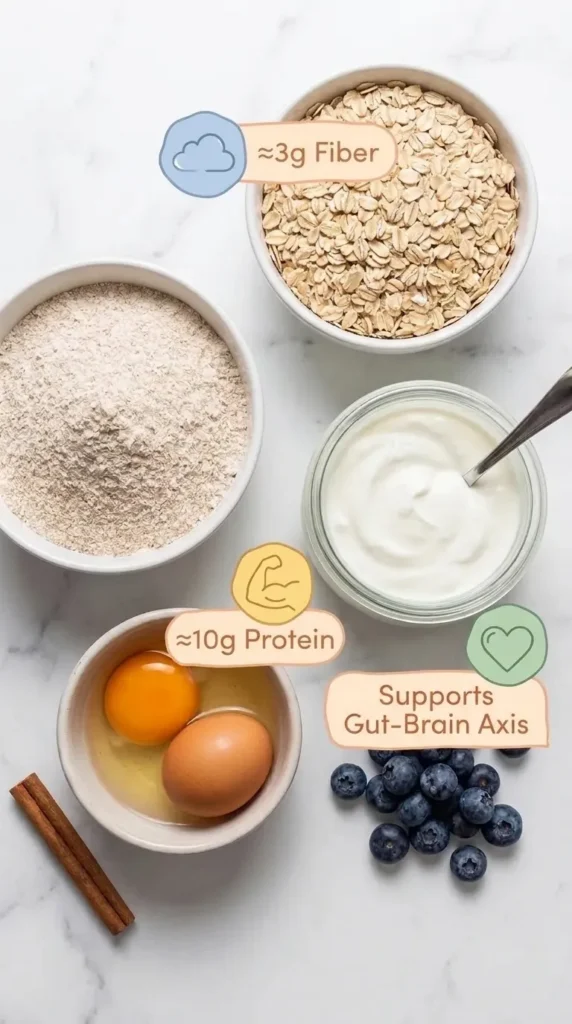
High protein pancakes for kids made with whole wheat flour, rolled oats and Greek yogurt. Each serving (2 pancakes) has about 10 g of protein and 3 g of fiber, more than a typical white flour pancake. Ready in 25 minutes, freezer-friendly, and yes, they’re fluffy.
Table of Contents
⚠️ Why White Flour Isn’t Doing Your Kid Any Favors
You didn’t do anything wrong. White flour is in almost every pancake mix ever made, so it’s what most of us grew up eating. The difference comes from how the flour is made.
When wheat is milled into white flour, the bran and germ are removed. Those are the parts that hold most of the fiber, along with minerals like magnesium and zinc. What’s left is mostly starch. Many white flours are enriched, which means iron and some B vitamins are added back, but fiber and most of the other nutrients are not.
Three things change when you swap in whole wheat:
1. More fiber, more staying power.
Refined starch is digested faster than the starch in whole grains, and a breakfast with fiber and protein tends to keep kids fuller for longer. As childhood nutrition expert Jill Castle, MS, RDN, explains, a breakfast with a protein source such as eggs, milk or yogurt “will help kids stay satisfied until lunch time.” The American Academy of Pediatrics’ HealthyChildren.org also links eating breakfast to better school performance, and recommends choosing whole grain cereals, which are higher in micronutrients than refined grains.
Research on breakfast and thinking skills is encouraging but limited, so think of a balanced breakfast as a good start, not a guarantee. Every child is different, so watch how yours feels after breakfast.
2. Fiber feeds gut bacteria.
Whole grains contain fibers that gut bacteria use as food. Research on the gut and children’s brain development is still early. A 2023 systematic review in Frontiers in Neuroscience (McMath et al.) analyzed 23 studies of healthy infants and children, mostly under age 5. Most were observational, and several bacteria, including Bifidobacterium, were linked to behavior, motor and language skills, though results were mixed and the authors call for higher-quality studies. A 2023 study in Frontiers in Pediatrics (Lapidot et al.) of 165 Israeli Arab children aged 6–9 found that a more diverse gut microbiome was modestly associated with higher IQ scores. Family socioeconomic status was much more strongly related to IQ, and the study could not tell which came first. Neither study tested flour or pancakes.
3. More minerals.
Researchers at UCSF presented preliminary findings at NUTRITION 2024, the American Society for Nutrition’s annual meeting. They milled wheat from a single farm and baked bread with three types of flour. Major minerals were reduced by up to 72% in refined flour and bread compared with the wheat kernel, and were virtually unchanged in whole wheat flours. These results were presented at a conference and had not yet been peer-reviewed.
✅ The Whole Wheat Fix: How to Keep Pancakes Fluffy
Here’s what usually stops parents:
“But whole wheat pancakes are dense and bitter, and my kids will notice immediately.”
Fair. That’s true of badly made whole wheat pancakes. These four habits make the difference:
- Rest the batter for 3–5 minutes. Whole wheat flour soaks up liquid, and the bran needs a few minutes to soften. A short rest gives a more tender pancake.
- Mix gently. Stir until just combined. A few lumps are fine.
- Use fresh flour. The germ in whole wheat flour contains natural oils that go stale over time, which is why old flour can taste bitter. Keep it in an airtight container, and in the fridge or freezer if you won’t use it within a few weeks.
- Blend it with oats. Oat flour makes the pancakes softer and the flavor milder than 100% whole wheat.
Want an even milder flavor? White whole wheat flour is made from a lighter-colored variety of wheat. It is still a whole grain, and many kids find it less “wheaty.”
The blend in this recipe. We use about 3 parts whole wheat flour to 1 part oat flour (¾ cup whole wheat flour and ¼ cup rolled oats, blended). Whole wheat brings fiber and minerals. Oats add beta-glucan, a soluble fiber, and a softer texture.
Go gradually if your kids are skeptical. Many pediatricians take the same practical approach. According to a TODAY.com article, Dr. Katie Lockwood, a pediatrician at Children’s Hospital of Philadelphia, uses some whole wheat flour in her baking because it has more vitamins, minerals and fiber than white flour. She usually swaps only half, because her kids don’t like her muffins entirely whole wheat. Her advice on breakfast in general: let kids “choose things that make them feel good.”
If your kids are used to white flour, start with half white and half whole wheat, then shift a little more each week. The full schedule is in the Picky Eater Strategy section below.
📊 White Flour vs. Whole Wheat Flour: What Changes ?
Approximate values for ½ cup of flour, based on USDA reference data. Brands vary, so check your label.
| All-purpose white flour (enriched) | Whole wheat flour | |
|---|---|---|
| Parts of the grain | Endosperm only | Bran, germ and endosperm |
| Fiber | about 2 g | about 6 g |
| Magnesium | about 12 mg | about 80 mg |
| Protein | about 6–8 g | about 8 g |
| Texture in pancakes | Fluffy, delicate | Fluffy, a little heartier |
White flour in the U.S. is usually enriched with iron and B vitamins. Fiber and magnesium are not added back.
🥗 Dietary Adaptations: One Recipe, Every Family
| Dietary need | Simple swap | Result |
|---|---|---|
| 🌾 Gluten-free | Certified gluten-free oat flour + a gluten-free 1:1 flour blend | Texture may differ slightly. If celiac disease is a concern, use certified gluten-free ingredients throughout. |
| 🥛 Dairy-free | Plant-based yogurt + oat or almond milk | Creamy, no dairy. Many plant yogurts have much less protein than Greek yogurt, so check the label. |
| 🥚 Egg-free | 2 flax eggs (2 tbsp ground flax + 6 tbsp water, rest 5 min) | Pancakes may be a little more delicate and have less protein. |
| 🌰 Nut-free | Sunflower seed butter instead of almond butter | The base recipe contains no nuts. Check labels for cross-contact. |
| 💪 Extra protein | Add 1 tbsp hemp seeds to the batter and serve with ½ cup cottage cheese | About 20 g of protein or more per serving |
| 🔽 Lower sugar | Omit the maple syrup from the batter, top with fresh berries | A good option for toddlers |

💡 Noah’s Tip for Texture-Averse Kids:
” Go gradually. Start with ¼ cup whole wheat + ½ cup white flour + ¼ cup oat flour. After two weeks, move to ½ cup whole wheat + ¼ cup white flour + ¼ cup oat flour. By week five, you’re on the full recipe. If your child notices a change, stay at that stage a little longer. The full schedule is in the Picky Eater Strategy section below.”
⏱️ Prep & Cook Time
| Time Category | Duration |
|---|---|
| Prep Time | 5–10 minutes |
| Batter Rest | 3–5 minutes |
| Cook Time | 12–15 minutes (more with a small skillet) |
| Total Time | About 25 minutes |
| Servings | 4 (about 8 pancakes, 2 per serving) |
| Difficulty | Beginner-friendly |
🛒 Ingredients
| Dry mix | Amount | Notes |
|---|---|---|
| Whole wheat flour | ¾ cup | Fresh, stored airtight. White whole wheat gives a milder flavor |
| Rolled oats | ¼ cup | Measured before blending, then blended 30 seconds |
| Baking powder | 1 tsp | |
| Baking soda | ¼ tsp | |
| Cinnamon | ½ tsp | |
| Sea salt | 1 pinch |
| Wet mix | Amount | Notes |
|---|---|---|
| Plain full-fat Greek yogurt | ¾ cup | Creamier texture and richer flavor |
| Large eggs | 2 | |
| Whole milk | ⅓ cup | Or a dairy-free milk |
| Pure maple syrup | 1 tbsp | Omit for toddlers under 2 |
| Pure vanilla extract | 1 tsp | |
| Coconut oil | 1 tbsp | For cooking |
Allergens
wheat (gluten), egg and milk. Rolled oats may be cross-contaminated with gluten unless labeled gluten-free.
Optional add-ins and toppings
- almond butter (tree nut)
- chocolate chips (may contain milk, soy or tree nuts)
🔪 Equipment You’ll Need
| Equipment | Purpose | Alternative |
|---|---|---|
| Blender or food processor | Turning oats into oat flour | Store-bought oat flour (about ¼ cup, 20–25 g) |
| Large mixing bowl | Combining dry ingredients | Any large bowl |
| Medium mixing bowl | Whisking wet ingredients | |
| Whisk | Combining wet ingredients | Fork works fine |
| Non-stick skillet or griddle | Cooking pancakes | Cast iron (use a little extra coconut oil) |
| ¼-cup measuring scoop | Portioning batter | Large spoon |
| Wide, thin spatula | Flipping | |
| Wire rack | Cooling pancakes before freezing (Sunday Prep) | Parchment-lined baking sheet |
👩🍳 Instructions
Step 1: Make Your Oat Flour
Add ¼ cup rolled oats to a blender or food processor and blitz for 30 seconds, until it looks like fine flour. Set aside. (Skip this step if you use store-bought oat flour.)
💡 Why this works: Blending the oats keeps the texture smooth, so the pancakes feel like regular pancakes to picky eaters.
Step 2: Mix Dry Ingredients
In a large bowl, whisk together the whole wheat flour, oat flour, baking powder, baking soda, cinnamon, and salt until evenly combined.
Step 3: Whisk Wet Ingredients
In a separate medium bowl, whisk Greek yogurt, eggs, milk, maple syrup, and vanilla until smooth. The yogurt will make the batter look thick — that’s exactly right.
Step 4: Combine and Rest the Batter
Pour the wet ingredients into the dry bowl. Stir gently until just combined; a few lumps are fine. Do not overmix. Let the batter rest for 3–5 minutes.
Why rest the batter? Whole wheat flour and oats soak up liquid, and the bran needs a few minutes to soften. A short rest gives a more tender pancake. Cook soon after resting, because the baking powder starts working as soon as the batter is wet.
Step 5: Heat Your Pan
Heat a non-stick skillet or griddle over medium-low to medium heat. Add a small amount of coconut oil and swirl to coat. The pan is ready when a small drop of batter sizzles gently. If it browns right away, lower the heat.

Step 6: Cook the Pancakes
Scoop ¼ cup of batter per pancake. If using blueberries, press 5–6 into the top of each pancake immediately after pouring (cut them in half for toddlers). Cook for 2–3 minutes until bubbles form across the surface and edges look set. Flip once and cook 1–2 minutes more until golden brown.
Do not press down with the spatula, which squeezes out the air.
Step 7: Serve
Serve warm. Top with a dollop of Greek yogurt, a thin spread of nut or seed butter, or a light drizzle of maple syrup (skip the syrup for children under 2). For toddlers, slice into ½-inch finger strips.
👶 How to Serve by Age
| Age Group | Format | Toppings | Notes |
|---|---|---|---|
| 18 months – 2 years | ½-inch finger strips | Plain Greek yogurt for dipping | Omit maple syrup from the batter and the toppings |
| 2 – 4 years | Small rounds (3 tbsp batter) | Fresh berries (halved for the youngest), tiny drizzle of maple syrup | Let them choose their own topping |
| 4 – 8 years | Standard size (¼ cup batter) | Berries, maple syrup, thin spread of seed butter | Great for shape-making with a squeeze bottle |
| 9 – 14 years | Stack of 3 | Nut or seed butter, banana, hemp seeds | Add a boiled egg on the side for about 25 g of protein in total |

🧠 Why These Ingredients Support Brain Health
Every ingredient in this recipe was chosen for a reason. Here is what each one brings to the plate. No single food determines how a child focuses, but a breakfast built from nutrient-rich ingredients is a good start to the day.
Whole wheat flour
Keeps the bran and germ, which hold fiber and minerals such as magnesium and zinc. Magnesium is involved in energy metabolism, and zinc in nerve signaling. (See the UCSF findings above: preliminary, but consistent with the idea that milling removes nutrients.)
Oat flour
Contributes beta-glucan, a soluble fiber that gut bacteria can use as food. One serving contains only a small amount (about 0.2 g), so think of it as a bonus. Research on gut bacteria and children’s cognition is still early.
Greek yogurt
Adds protein and calcium. Casein, its main protein, digests slowly, which helps kids feel full longer. Cooking destroys most live cultures, so these pancakes are not a probiotic food. For live cultures, serve plain Greek yogurt on the side (check the label for “live and active cultures”).
Eggs
Are among the richest dietary sources of choline, which the body uses to make acetylcholine, a neurotransmitter involved in memory. One serving of these pancakes provides about 90 mg of choline, a bit more than a third of the 250 mg adequate intake for ages 4–8.
Blueberries (optional)
Provide fiber and anthocyanins, the pigments that give them their deep color. A few small studies from one UK research group found that children aged 7–10 did better on some memory and attention tasks after a blueberry drink, but with roughly 1 to 1½ cups of fresh berries’ worth in one sitting, and results varied between studies. Here each serving gets about ⅛ cup, so enjoy them for their taste, fiber and color.
The bottom line : A breakfast with whole grains, protein and fruit gives kids fiber, protein, choline and minerals. It is a solid start to the day, not a guarantee of anything.
📊 Nutrition Information (Per Serving — 2 pancakes)
| Nutrient | Amount | % Daily Value* |
|---|---|---|
| Calories | about 220 | — |
| Protein | about 10 g | 20% |
| Carbohydrates | about 26 g | 9% |
| Dietary fiber | about 3 g | 11% |
| Total fat | about 8 g | 10% |
| Saturated fat | about 4 g | 20% |
| Iron | about 1.5 mg | 8% |
| Magnesium | about 50 mg | 12% |
| Choline | about 90 mg | 16% |
Percent Daily Values are based on a 2,000 calorie diet. Values are approximate, calculated for the base recipe (4 servings of 2 pancakes, without optional add-ins or toppings), and vary by brand.
😤 Picky Eater Strategy
Complexity kills execution. Here are five ideas, from least to most effort. Pick one or two, not all five.
The Chocolate Chip Bridge. Press 3–4 chocolate chips into each pancake while it cooks (dark chocolate, 70% or more, if your child likes it; semi-sweet is milder). Many kids welcome a little chocolate, and the whole wheat is less noticeable. After 2–3 weeks, try using half as many chips. Skip this one for children under 2, since the recipe leaves out added sugar at that age. If your child has a milk, soy or nut allergy, check the chocolate label.
The Squeeze Bottle Trick. Pour the batter into a clean squeeze bottle (if it is too thick to flow, thin it with 1–2 tablespoons of milk) and let kids choose the shape: their name, a dinosaur, a heart. A grown-up should do the pouring on the hot griddle, and kids can direct. Many children enjoy eating something they helped design.
The Gradual Swap. Start with half white flour and shift toward whole wheat over about five weeks, always keeping 1 cup of flour in total:
- Weeks 1–2: ¼ cup whole wheat + ½ cup white flour + ¼ cup oat flour
- Weeks 3–4: ½ cup whole wheat + ¼ cup white flour + ¼ cup oat flour
- Week 5 on: ¾ cup whole wheat + ¼ cup oat flour (the full recipe)
If your child notices a change, slow down and stay at that stage for another week.
Kids Who Cook, Kids Who Eat. Let them stir the batter, count the blueberries or press the chocolate chips in. Reviews suggest that children’s cooking programs may positively influence food preferences (Hersch et al., 2014), and kids who help prepare meals at home tend to eat more fruits and vegetables (Quelly, 2019). Much of this evidence is observational and self-reported. It will not turn a picky eater overnight, but it is a low-pressure way to build familiarity.
The Rename. Call them “Superhero Pancakes” or “Noah’s Power Pancakes.” A fun name can make a new food feel more like play. Not manipulation, just meeting them where they are.


📅 Sunday Prep: Double the Batch, Freeze for School Mornings
Make a double batch on Sunday. It adds about 15 minutes, mostly extra cooking time (more if you use a small skillet). A double batch makes about 16 pancakes, roughly 8 servings of 2, enough for several school mornings. Here’s the system:
- Cook all the pancakes, then cool them completely on a wire rack (about 15 minutes). Freeze within 2 hours of cooking.
- Freeze flat on a parchment-lined baking sheet for about 1 hour.
- Transfer to a zip freezer bag, pressing out as much air as possible.
- Label with the date. For best quality, eat them within about 3 months. They stay safe in the freezer longer, but they can dry out and lose flavor.
School morning reheat : Microwave from frozen for about 45–60 seconds for 2 pancakes (adjust for your microwave), or warm in a toaster or skillet for a crisper edge. The USDA recommends reheating leftovers to 165°F (74°C). Microwaves heat unevenly, so check that the center is steaming hot, then let the pancakes cool for a minute before serving them to your child.
Total hands-on Sunday time: about 40 minutes. Total school morning time: about 2 minutes. This is the version of “meal prep” that actually survives real family life.

🎥Added Bonus
❓ FAQs
Can I use 100% whole wheat flour instead of the oat blend?
Yes. Replace the oat flour with an equal amount of whole wheat flour (1 cup in total). The pancakes will be a little heartier and the flavor more “wheaty.” If the batter looks too thick after resting, add a splash of milk (1–2 tablespoons). White whole wheat flour gives a milder flavor. The oat blend is there to make the transition easier for picky eaters. If your family already likes whole grains, you can go all whole wheat.
How much protein do these pancakes really have?
About 10 g per serving of 2 pancakes (4 servings per batch), based on ¾ cup of Greek yogurt with about 15 g of protein. The exact number depends on your yogurt: a higher-protein yogurt will give you more. That is roughly double the protein of two plain pancakes made from a typical white-flour recipe.
Is whole wheat flour safe for toddlers?
Yes, for children who already eat wheat, eggs and dairy. This recipe is written for toddlers from about 18 months, who can handle finger strips, but whole wheat flour itself is not the reason for that age. If your child has not tried wheat, egg or dairy yet, introduce them one at a time first and ask your pediatrician when to start. If your child has a wheat sensitivity or there is celiac disease in the family, talk to your pediatrician and use the gluten-free adaptation in the Dietary Adaptations table above.
Does the type of flour affect my child’s focus?
No single food decides how well a child focuses. Whole grains tend to be digested more slowly than refined grains because of their fiber, and a breakfast with fiber and protein tends to keep kids fuller for longer. Research linking breakfast to school performance is mostly observational, so it shows associations, not proof. These pancakes are a balanced, satisfying option, not a guarantee of anything.
Can I add protein powder for extra protein?
Usually unnecessary. Most children who eat a varied diet get enough protein, and this recipe already has about 10 g per serving from whole foods. If a dietitian or pediatrician has recommended extra protein for your child, ask them what to use, since protein powders can change the texture of pancakes and often contain milk. For a whole-food boost, serve the pancakes with plain Greek yogurt, a boiled egg or a thin spread of nut or seed butter.
What are good toppings for these pancakes?
Good options: a thin spread of almond or sunflower seed butter, fresh berries, plain Greek yogurt, or a small drizzle (about 1 teaspoon) of pure maple syrup. Skip the maple syrup for children under 2. Go easy on pancake syrups, jam and whipped cream, which add sugar quickly without much else. For toddlers, spread nut and seed butters thinly, since thick spoonfuls can be a choking hazard.
How is oat flour different from using just rolled oats in the batter?
Blending the oats into flour gives a fine, even texture that mixes smoothly into the batter. Whole rolled oats added directly stay chunky, soak up liquid unevenly and make the pancakes heavier. Blending does not change the oats’ nutrition, so you keep their fiber, including beta-glucan, with a texture much closer to a regular pancake.
🧾 Keep Exploring
If your family loves these High Protein Pancakes, try these other brain-building breakfasts:
- Nutritious Breakfast for Kids Brain Development: Avocado Toast with Egg — Choline + monounsaturated fats + complex carbs in one plate
- Golden Scrambled Eggs for Toddlers — Pair with these pancakes to cover both protein AND choline in one morning
- Brain-Boosting Smoothie for Kids — The 5-minute after-school recharge
- Foods to Help Kids Focus — The complete brain food blueprint: iron + zinc + DHA