Omega-3 Smoothie Bowl for Focus: Flaxseed, Chia & Walnut Brain-Building Breakfast Kids Actually Eat
You’ve read that Omega-3s are crucial for brain development. And you’re standing in your kitchen at 7:23 AM with a kid who just rejected toast for the third morning in a row.
Here’s the truth: Complexity kills execution. You need one Omega-3 smoothie bowl that looks like dessert, tastes like a treat, and secretly delivers the omega-3s that build better brains.
Table of Contents
🧠 Why This Omega-3 Smoothie Bowl Builds Brains ?
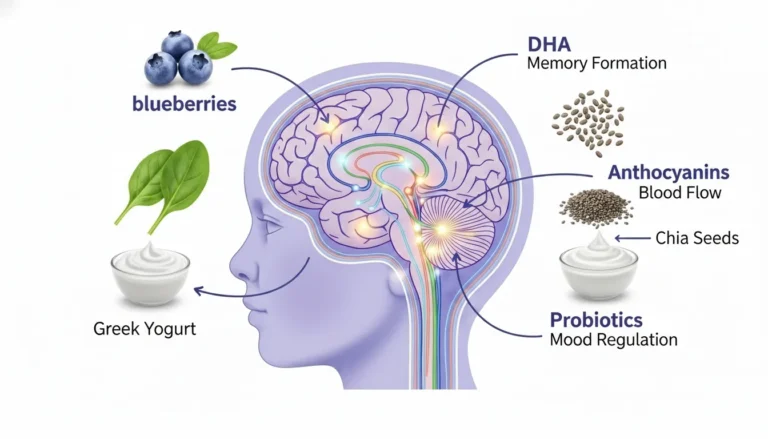
Your child’s brain is building approximately 700 new neural connections per second during early childhood. DHA (docosahexaenoic acid) makes up 97% of the omega-3 fatty acids in the brain.
🧪Research-Backed Science
Omega-3s and ADHD Symptoms: A 2017 meta-analysis published in Neuropsychopharmacology examined 7 randomized controlled trials with 534 children and found that omega-3 supplementation improved ADHD clinical symptom scores and cognitive measures associated with attention in children and adolescents.
(Source: Neuropsychopharmacology, 2017)
DHA and School Performance: A systematic review in Nutrients (2013) analyzing 15 studies found that five out of seven studies reported that DHA status or supplementation improved measures of school performance including learning ability, reading, and spelling.
Visual and Cognitive Development: Research published in the British Journal of Nutrition demonstrated that children whose mothers had higher DHA content at delivery were more likely to have Mental Processing Composite scores above the median at 6.5 years.
(Source: British Journal of Nutrition, 2012)
DHA supports brain structure, visual development, and memory. EPA regulates mood, focus, and reduces hyperactivity.
Recommendation: 250-500mg combined DHA+EPA daily for children ages 4-12. Consult your pediatrician for personalized guidance.
🔪 Equipment You’ll Need
- High-speed blender
- 2 medium bowls
- Measuring spoons
- Sharp knife for toppings
Pro tip: If your blender struggles with frozen fruit, let it sit at room temperature for 5 minutes first.
🥣 The Omega-3 Smoothie Bowl Recipe
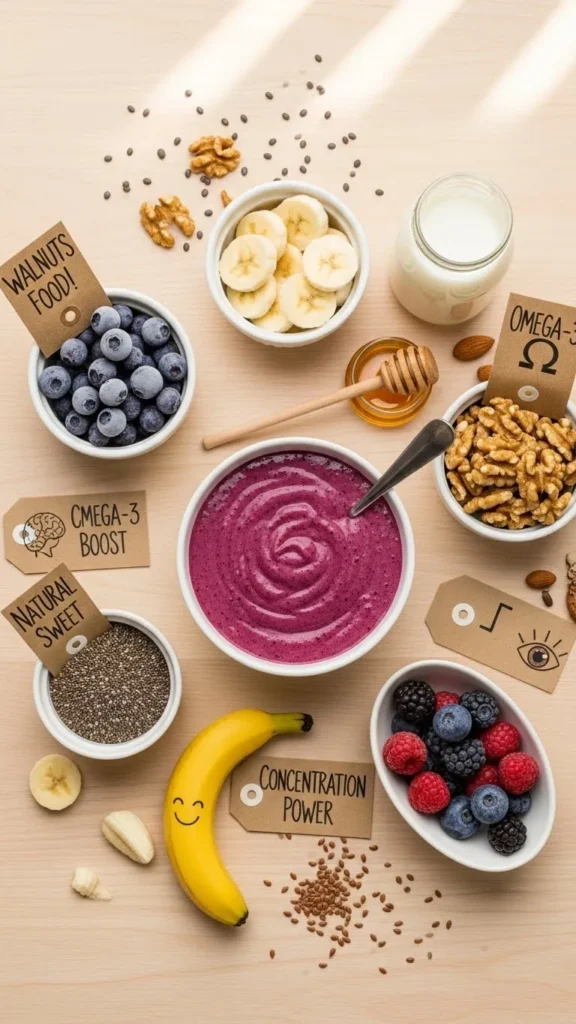
🛒Base Ingredients (2 servings)
Omega-3 Powerhouses:
- 1 cup frozen wild blueberries (anthocyanins + brain protection)
- 2 tablespoons ground flaxseed (2,350mg ALA omega-3 per tbsp)
- 1 tablespoon chia seeds (2,400mg ALA omega-3 per tbsp)
- ¼ ripe avocado (healthy monounsaturated fats for nutrient absorption)
Creamy Deliciousness:
- 1 frozen banana (the secret to ice cream texture)
- ½ cup full-fat Greek yogurt (protein + probiotics)
- ½ cup unsweetened almond milk (or any milk)
- 1 teaspoon pure vanilla extract
- 1 teaspoon raw honey (optional, for kids 12+ months)
Toppings (Choose 3-4):
- Fresh berries (blueberries, strawberries)
- Sliced banana
- Crushed walnuts (140mg ALA omega-3 per tbsp—more brain fuel!)
- Unsweetened coconut flakes
- Hemp hearts (1,000mg ALA omega-3 per tbsp)
- Dark chocolate chips (70%+ cacao for antioxidants)
- Low-sugar granola clusters
👩🍳Instructions
Sunday Prep Option (30 minutes for the week):
- Pre-portion all base ingredients into 5 freezer bags
- Label each bag “Smoothie Bowl + date”
- Store flat in freezer
- Each morning: dump one bag into blender, add milk, blend 60 seconds
Morning-Of Method:
- Add all base ingredients to blender
- Blend on high for 45-60 seconds until thick and creamy
- The texture test: Should be thick enough that a spoon stands up in it
- Divide into two bowls
- Arrange toppings in rows (visual appeal = more likely to eat)
- Serve immediately
Omega-3 content per serving: Approximately 3,500-4,000mg ALA (plant-based omega-3), which converts to roughly 350-400mg DHA/EPA equivalent.
Time investment: 5 minutes with prep, 3 minutes morning-of with pre-portioned bags.
🧒 Why Kids Will Love This ?
This bowl wins because:
- It looks like ice cream – Thick, colorful, scoopable texture
- They get to “decorate” – Let them arrange toppings. Control = buy-in
- Natural sweetness – Kids register this as candy-level sweet
- Cold and refreshing – Perfect for mornings
- Crunchy toppings – Textural contrast is sensory gold
The psychology: This doesn’t taste “healthy.” It tastes like a treat they’re getting away with for breakfast.
👶 How to Serve by Age ?
Ages 12-18 Months:
Puree smooth, thin with extra milk. ¼ cup portion. Mashed banana only as topping.
Ages 18 Months – 3 Years:
Thick consistency. ½ cup portion. Soft berries, small banana pieces, ground nuts only.
Ages 3-5 Years:
Full thickness. ¾ cup portion. All toppings except whole nuts. Let them choose 3 toppings.
Ages 5-8 Years:
Extra thick. 1 cup portion. All toppings including whole walnuts. Challenge them to create patterns.
Ages 9-12 Years:
1-1.5 cups. Let them build their own creation. Teach them to make it themselves.
🍎 Picky Eater Battle Plan
Strategy 1: The Stealth Method
Start with just banana + yogurt + milk. Add ½ tablespoon chia seeds (they look like sprinkles!). Next week, add ¼ cup blueberries. Gradually increase over 3-4 weeks. Taste bud adaptation takes time.
Strategy 2: The Decoy Approach
Blend everything smooth, call it “Purple Ice Cream for Breakfast.” The chia and flax disappear into the blueberry color. Branding matters.
Strategy 3: The Partnership Model
Let them add toppings, give them 3-4 choices, let them stir in the chia seeds. Ownership breeds acceptance.
Strategy 4: The Consistency Play
Serve the same breakfast for 5 days straight. Kids need 15-20 exposures to accept new foods. Don’t ask “Do you want this?” Just serve it.
What NOT to Do: Don’t beg, bribe, make “yucky” faces, or compare to siblings. Pressure creates resistance.
🔄 Dietary Adaptations
| Dietary Need | Swap This | For This | Notes |
|---|---|---|---|
| Dairy-Free | Greek yogurt | Coconut yogurt or silken tofu | Use full-fat coconut for creaminess |
| Nut-Free | Almond milk, walnuts | Oat milk, sunflower seeds | Sunflower seeds: 74mg omega-3/tbsp |
| Vegan | Greek yogurt, honey | Coconut yogurt, maple syrup | B12 supplementation recommended |
| Low-FODMAP | Banana, honey | ½ cup frozen strawberries, maple syrup | Use firm banana only |
| Seed-Free | Chia, flax, hemp | Add 2 tbsp walnuts + ¼ avocado | Maintains omega-3 levels |
| AIP (Autoimmune Protocol) | Chia, flax seeds | ¼ avocado + 2 tbsp coconut | Lower omega-3 but gut-healing |
| Texture-Averse | All seeds visible | Grind everything into powder first | Completely smooth texture |
Allergy-Friendly Omega-3 Sources
If your child can’t have common omega-3 foods:
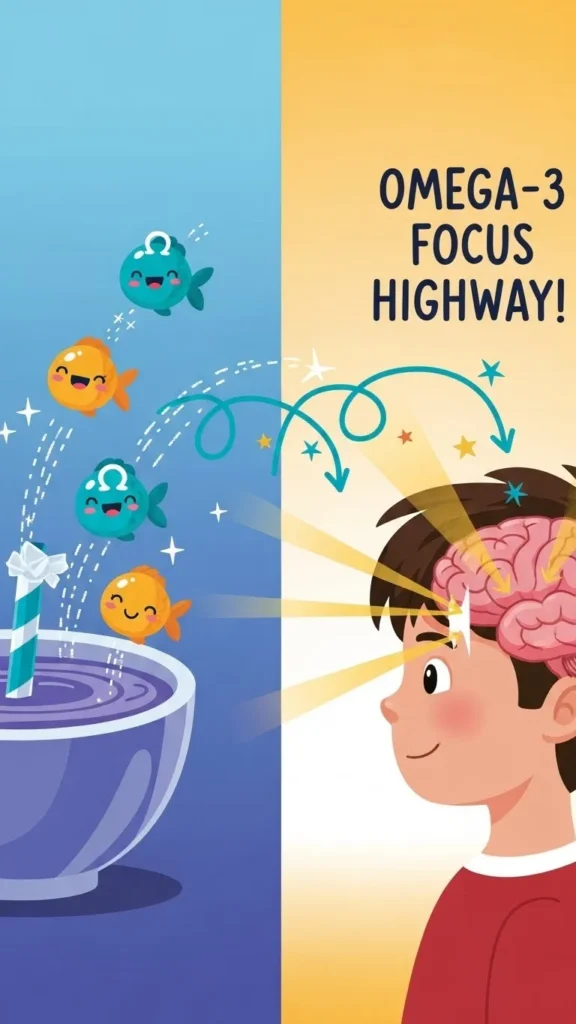
- Algae oil: Direct source of DHA (200-300mg per ½ tsp) – this is what fish eat to get their omega-3s
- Fortified foods: Some orange juices have 50mg DHA per cup
- Supplements: Nordic Naturals makes kid-friendly DHA drops
🧾 Related Recipes
Build out your brain-boosting breakfast rotation with these complementary omega-3 rich recipes from MiniChef:
🍞 Egg and Avocado Toast with Smoked Salmon Complete omega-3 breakfast with DHA from salmon, healthy fats from avocado. Ready in 10 minutes.
🐟 Baked Salmon with Quinoa and Broccoli Rich in omega-3 fatty acids for dinner. Leftovers make excellent lunch box additions.
🥤 7 Kid-Friendly Probiotic Drinks Includes smoothie recipes with chia seeds. Gut health meets brain health.
🥣 10 High-Fiber Breakfasts for Kids Features flaxseed and chia seed breakfast options. More brain-boosting morning meals.
🧠 Zinc-Rich Recipes: Brain-Boosting Meals Complementary micronutrients for cognitive development. Complete the nutrition picture.
✨ The Bottom Line
You’re not going to get this perfect, and that’s fine.
Some mornings your kid will demolish this bowl. Other mornings they’ll take one bite and walk away. Both mornings, you’re doing great.
The goal isn’t perfection. It’s progress over time. Every smoothie bowl delivers omega-3s that support neural connections, brain tissue development, and focus they’ll need for decades.
And you’re doing it without a battle, without fish oil torture, without supplements they spit out.
That’s strategic parenting.
Now go blend something purple. 🧠💜
Sources:
- Chang, J.P., et al. (2019). “Omega-3 Polyunsaturated Fatty Acids in Youths with Attention Deficit Hyperactivity Disorder.” Nutrients, 11(10), 2325.
- Montgomery, P., et al. (2012). “Fatty Acids and Sleep in UK Children: Subjective and Pilot Objective Sleep Results.” PLoS One, 7(8).
- Stonehouse, W. (2014). “Does Consumption of LC Omega-3 PUFA Enhance Cognitive Performance in Healthy School-Aged Children?” Nutrients, 6(7), 2777-2810.
Note: This article provides educational information about nutrition and child development. It is not medical advice. Always consult your pediatrician before making significant dietary changes, especially for children with allergies, health conditions, or specific nutritional needs.
❓ FAQs
Q: Can I use fresh fruit instead of frozen?
Yes, but add 1 cup ice cubes for thick texture. Frozen fruit is flash-frozen at peak ripeness for optimal nutrients.
Q: My kid hates seeds. Can I hide them?
Grind flax and chia into fine powder using a coffee grinder. They’ll disappear into the purple color.
Q: How long does this keep?
Best consumed immediately. Will keep 24 hours refrigerated but gets icier. Stir well before serving.
Q: Can I make this the night before?
Pre-portioned freezer bags work better. Blend in the morning—takes 3 minutes.
Q: Is flax seed as good as fish oil?
Flax provides ALA, which converts to DHA/EPA at 5-10% efficiency. Solid plant-based option, but if your child eats zero fish, consider an algae-based DHA supplement.
Q: My kid ate two bites and walked away. Now what?
Normal. Offer again tomorrow. No commentary. Remember: 15-20 exposures. You’re playing the long game.